A patriot's seder
Published July 8, 2026
By Gary Pearce
Our friends and neighbors Jill and Dr. Jeff Braden put on a memorable July 4th feast - one that gave us a new appreciation for the holiday’s real meaning.
Jeff - retired professor of psychology and dean of the College of Humanities and Social Sciences at N.C. State University - had done his homework for our neighborhood gathering Saturday.
First, we stuffed ourselves with burgers and hot dogs, which Jeff grilled outside in 100-degree-plus heat - and chips, deviled eggs, watermelon, veggies and dip, potato salad, baked beans and other all-American snacks and beverages.
Then, as the 10 of us sat around the long dining table, Jeff led us in what he titled “A Patriots’ Seder,” combining Jewish tradition with our nation’s 250thanniversary.
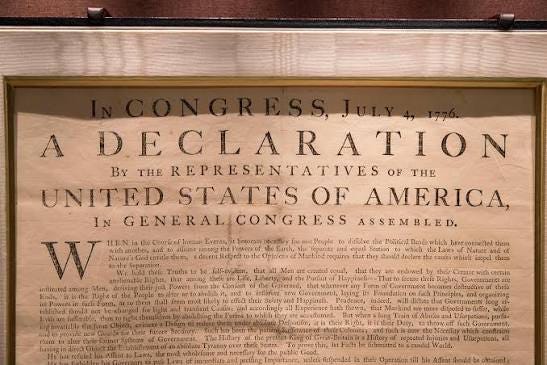
Together and as individual participants, we read aloud the words of the Declaration of Independence.
We were reminded that the holiday may be past, but our patriots’ responsibilities always endure.
As Jeff wrote:
Although we recognize the flaws, contradictions, and imperfections that existed in our founding ideals from the beginning of this country, we embrace the challenge “to form a more perfect Union” and the checks and balances that guide our democracy in that endeavor. Today, we remember—and today, we pledge to act so that we and our children will enjoy the blessings of life, liberty, and the pursuit of happiness.
Following is his text:
Leader: Every year, US citizens celebrate our freedom on the 4th of July in honor of the Continental Congress’s approval of the Declaration of Independence on this date in 1776. We pause—or, more likely, should pause—to remember the significance of this event, and how our founders changed not only our country but the course of world history.
Every year at Passover, Jews around the world celebrate our freedom in honor of our ancestors’ exodus from Egypt in a dinner and shared reading we call a Seder. We pause to remember and appreciate our freedom, and how God and our ancestors changed not only Jewish history but created a legacy of freedom for all.
A Seder is a script in which some parts are read by the leader, some by participants, and some together as a group. Let us begin with a collective reading:
All: Today, we merge the traditions of Independence Day and Passover to commemorate and remember our shared history of independence from tyrants. Whether they be pharaohs, despots, or kings, they shall not abide in our country—and we, as independent and free people, shall not tolerate them.
Leader: We will now begin our reading of the Declaration of Independence. Some parts are taken word for word from the original text; others have been abridged to shift the focus from specific historical contexts to universal principles of democracy, governance, and freedom. Let me begin: “In Congress, July 4, 1776: The unanimous Declaration of the thirteen united States of America” Together:
All: When in the Course of human events, it becomes necessary for one people to dissolve the political bands which have connected them with another, and to assume among the powers of the earth, the separate and equal station to which the Laws of Nature and of Nature’s God entitle them, a decent respect to the opinions of mankind requires that they should declare the causes which impel them to the separation.
We hold these truths to be self-evident, that all men are created equal, that they are endowed by their Creator with certain unalienable Rights, that among these are Life, Liberty and the pursuit of Happiness.
Participant: That to secure these rights, Governments are instituted among Men, deriving their just powers from the consent of the governed.
Participant: That whenever any Form of Government becomes destructive of these ends, it is the Right of the People to alter or to abolish it, and to institute new Government, laying its foundation on such principles and organizing its powers in such form, as to them shall seem most likely to effect their Safety and Happiness.
Participant: Prudence, indeed, will dictate that Governments long established should not be changed for light and transient causes; and accordingly all experience hath shewn, that mankind are more disposed to suffer, while evils are sufferable, than to right themselves by abolishing the forms to which they are accustomed.
Participant: But when a long train of abuses and usurpations, pursuing invariably the same Object evinces a design to reduce them under absolute Despotism, it is their right, it is their duty, to throw off such Government, and to provide new Guards for their future security.
Participant: Such has been the patient sufferance of these Colonies; and such is now the necessity which constrains them to alter their former Systems of Government. The history of the present King of Great Britain is a history of repeated injuries and usurpations, all having in direct object the establishment of an absolute Tyranny over these States. To prove this, let Facts be submitted to a candid world.
Leader: Here we will depart from the exact reading of the Declaration to summarize the specific historical grievances into ten enduring principles that guide a democratic form of government.
Participant: Obstruction of the Democratic Process. The Crown repeatedly blocked, delayed, or outright refused to pass vital laws necessary for the public good, paralyzing the colonies’ ability to govern themselves.
Participant: Suppression of Representative Government. The King dissolved local legislative bodies for opposing his policies, refused to allow new elections, and forced assemblies to meet in remote, exhausting locations to coerce compliance.
Participant: Violation of Right to Representation. The Crown conditioned the passage of essential laws on communities giving up their right to legislative representation, a fundamental tool of self-governance.
Participant: Manipulation of the Judiciary. The King obstructed justice by refusing to establish local courts and made judges entirely dependent on the King’s will for their jobs and salaries, destroying judicial independence.
Participant: Weaponization of Bureaucracy. The Crown created an influx of unnecessary new government offices and sent “swarms of officers” to harass citizens, enforce intrusive regulations, and drain local resources.
Participant: Subversion of Civil Authority to the Military. The King maintained standing armies in the colonies during times of peace without local legislative consent, explicitly positioning military power as superior to civilian rule.
Participant: Denial of Fair Legal Due Process. The government deprived citizens of the right to a trial by jury, transported colonists overseas for mock trials on fabricated charges, and protected criminal soldiers from punishment.
Participant: Economic Warfare and Taxation Without Consent. The Crown severely restricted free enterprise by cutting off global trade networks and imposed arbitrary taxes on the colonists without their input or agreement.
Participant: Annihilation of Local Law and Self-Rule. The British government revoked established colonial charters, abolished protected legal systems, suspended local legislatures, and declared total power to legislate for the colonies in all cases.
Participant: Direct Warfare and Incitement of Violence. The King abdicated his protective duty by waging active war against the colonies—employing foreign mercenaries, destroying coastal towns, forcing captured citizens to fight their fellow citizens, and inciting internal insurrections.
All: We, therefore, the Representatives of the united States of America, in General Congress, Assembled, appealing to the Supreme Judge of the world for the rectitude of our intentions, do, in the Name, and by Authority of the good People of these Colonies, solemnly publish and declare, That these United Colonies are, and of Right ought to be Free and Independent States; that they are Absolved from all Allegiance to the British Crown, and that all political connection between them and the State of Great Britain, is and ought to be totally dissolved; and that as Free and Independent States, they have full Power to levy War, conclude Peace, contract Alliances, establish Commerce, and to do all other Acts and Things which Independent States may of right do. And for the support of this Declaration, with a firm reliance on the protection of divine Providence, we mutually pledge to each other our Lives, our Fortunes and our sacred Honor.
Leader: Although we have just completed our reading of the Declaration of Independence, our Seder is not complete. Simply remembering the past is insufficient. As Americans and free people, we must use the past to steer our present and guide our future. Together:
All: Although we recognize grievances and harms as the historical basis for the founders’ declaration, we understand these are not artifacts to be appreciated solely for their historical significance. Rather, we recognize that these acts continue to threaten our freedom, independence, and sovereignty as individuals and our country. We therefore pledge to rededicate ourselves to the privileges of freedom—and to our obligations as citizens to depose tyrants, despots, and those who traffic with them wherever and whenever they threaten freedom.
Leader: Although we are justly proud of our country and its history, we understand we are not—and have never been—perfect. Eleven years later, our founders wrote:
All: We the People of the United States, in Order to form a more perfect Union, establish Justice, insure domestic Tranquility, provide for the common defence, promote the general Welfare, and secure the Blessings of Liberty to ourselves and our Posterity, do ordain and establish this Constitution for the United States of America.
Participant: The wording “a more perfect Union” is not accidental. The founders understood that America is a work in progress—and that progress requires us to interrogate and challenge the past to make a more perfect present for all citizens.
Participant: We recognize that Jefferson’s grievance against King George III, accusing him of waging “cruel war against human nature itself” by forcing the slave trade upon unwilling colonists, was omitted from the final draft to secure the votes of Northern and Southern colonies.
Participant: We recognize that women are not mentioned in the Declaration (or the Constitution). The founders—all white men, most of whom owned slaves—limited their definition of “inalienable Rights, that among these are Life, Liberty and the pursuit of Happiness” to white, land-owning males.
Participant: We also recognize that the finalized Declaration re-framed the conflict inherent in Westward expansion as the King “endeavoring to bring on the inhabitants of our frontiers, the merciless Indian Savages” rather than acknowledging Indians were defending their own lands from colonial invasion.
Leader: Although we recognize the flaws, contradictions, and imperfections that existed in our founding ideals from the beginning of this country, we embrace the challenge “to form a more perfect Union” and the checks and balances that guide our democracy in that endeavor. Today, we remember—and today, we pledge to act so that we and our children will enjoy the blessings of life, liberty, and the pursuit of happiness.
All: Today we rededicate ourselves to founding principles by exercising our rights and embracing our responsibilities. We will hold ourselves and each other accountable to vote, to exercise our free speech in defense of our rights, to advance the rule of law, and to uphold the Constitution of the United States against all enemies—foreign and domestic.
[Raise your glass] Let freedom ring!
You can subscribe to Gary's substack here