AI, Political Attack Ads, and the Erosion of Trust
Published 2:13 p.m. today
Jennifer Balkcom’s campaign authorized an ad, paid for by the National Republican Congressional Committee, using what appears to be artificial intelligence (AI) to depict her opponent, Democrat Jamie Ager, as hosting a ‘drag queen barn dance’ in the highly competitive Eleventh Congressional District contest in western North Carolina.
The basis for the Republican ad appears to be an article that says in 2019, the farm Ager owns hosted an event:
On May 4, 2019, Hickory Nut Gap hosted its six-hour “Fantasy Festival at the Farm,” which was open to the public and drew about 1,500 Facebook responses. Organizers encouraged attendees to “put on your fairy wings or Vader helmet” and advertised interactive games for all ages, a costume contest for those 13 and older, and a separate contest for children 12 and younger.
This apparently gave license¹ to the National Republican Congressional Committee to create the ad with what appears to be generated backgrounds and individuals; as noted by the Raleigh News & Observer’s article:
Balkcom’s ad does not include a disclaimer stating that AI was used to generate any of its content.
After the ad’s release, one of the individuals profiled in the ad said she has never met Ager, while the Ager campaign has denounced the ad.
Here’s the introduction to both ads:
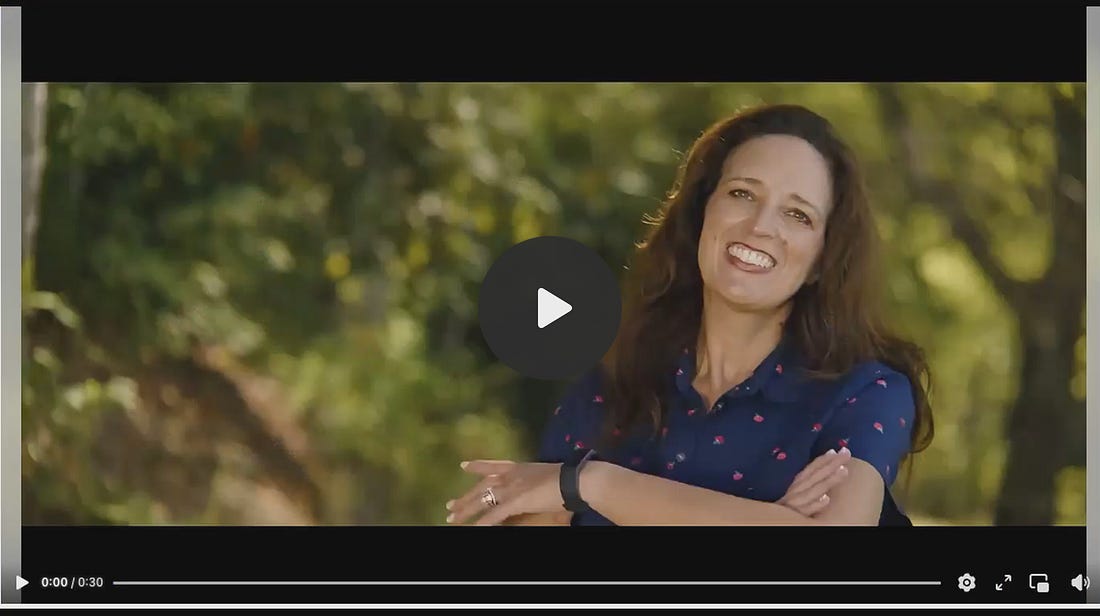
As you can see, the Balkcom ad uses the Ager ad’s introduction, but inserts a pride flag behind the Democratic candidate, followed by drag queens in the crowd, while citing the Breitbart article.
Currently, North Carolina is one of nineteen states with no regulations on the use of AI-generated political content, such as what appears to be the Balkcom ad.
In September, a national survey was conducted by Catawba College & YouGov regarding election confidence and the role of AI in campaigns and elections. The survey found that while nearly three-quarters of Americans report seeing at least some artificial intelligence in campaigns and elections, majorities say that AI’s overall effect on democracy will be negative (53%) and will introduce major or new problems in political messaging (50%). Two-thirds (68%) are very or somewhat concerned about AI’s use in this year’s midterm elections.
Ads such as Balkcom’s fit into the concerns that Americans express: they can’t trust what they see in campaigns and elections when AI inserts itself into political content. Nearly eight in 10 (78%) are concerned about AI used to spread misleading political content that looks real, with 72% believing that people will become less confident that election-related content is real.
Three-quarters say it is likely that AI will make it harder to tell whether campaign information is authentic. Similarly, 74% say they would be very or somewhat worried that a realistic video of a candidate making a controversial statement could be fake.
According to the News & Observer, North Carolina is one of 19 states that have no regulations regarding the use of AI in political content, meaning that “candidates in this state are more or less free to use AI however they please in their campaign ads.”
Americans overall want AI-political content regulated, according to the survey:
-
Eighty-five percent favor requiring labels or disclaimers on AI-generated political content
-
Eighty-five percent favor making it illegal to distribute AI-generated content that falsely depicts a candidate or election official saying or doing something they did not say or do.
-
Eighty-three percent agree that regulations are needed to address deceptive AI-generated election content
-
Eight-one percent favor holding social media platforms responsible for removing deceptive AI election content.
Notably, most Americans want the federal government to establish regulations for AI-generated political content. When asked to rank order who should be responsible for the regulations, 36% said the federal government, followed by technology companies developing AI tools at 18%, campaigns and political parties at 14%, state government at 11%, and social media companies at 10%.
The content of ads such as the Balkcom campaign-approved one is something that utilizes a wedge issue to create a ‘guilt by association’ against their opponent. And with the increased use of transgender as a GOP campaign attack, Republicans are hoping this will motivate their base, topping their traditional issues of crime and immigration. According to theWesleyan Media Project:
Anti-trans attacks make up 18 percent of all ads for Senate Republicans, followed by trumpeting their activities to reduce crime and fix issues at the border.
This ad may be the late October ‘surprise’ needed for the Republicans in the NC 11th Congressional District: as of today (10-27), only one-quarter of the absentee ballots cast so far (and overwhelmingly from in-person voters) are from registered Republicans in the district (you can find all of the dynamics of early voting at this webpage).
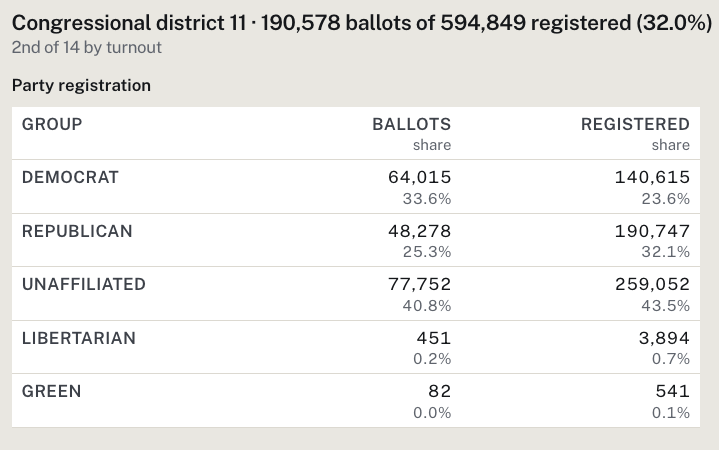 |
In comparison, registered Republicans make up nearly a third of the 11th Congressional District’s voter pool.
The political impact of the Balkcom ad remains to be seen. In North Carolina’s 11th Congressional District, the ad’s timing may be consequential in the final week of the race that the Cook Political Report has moved into “Lean Democratic” for next Tuesday. Whether the ad helps mobilize Republican voters—or changes the dynamics of the race—is an open question.
But the broader implications extend well beyond one congressional contest. When campaigns can use AI to place people in scenes they may never have participated in, or create political content without clearly disclosing how it was produced, voters face a growing challenge in determining what is real and what is manufactured.
The Catawba College-YouGov findings suggest that Americans recognize this danger. Overwhelming majorities favor labeling AI-generated political content and prohibiting fabricated content that falsely depicts candidates or election officials. These are not marginal concerns; they go to the heart of whether voters can trust the information they encounter during a campaign.
Political campaigns have always sought to frame opponents in the least favorable light; that’s the nature of our modern politics. But there is a difference between making a damaging argument about an opponent and using AI to create a misleading impression of reality. As AI becomes a more common feature of political advertising, the challenge for candidates, policymakers, and voters will be to ensure that technological innovation does not come at the expense of public trust and confidence in elections.
Americans are wary that the engines of our democracy—elections—could take a hit in the age of AI.
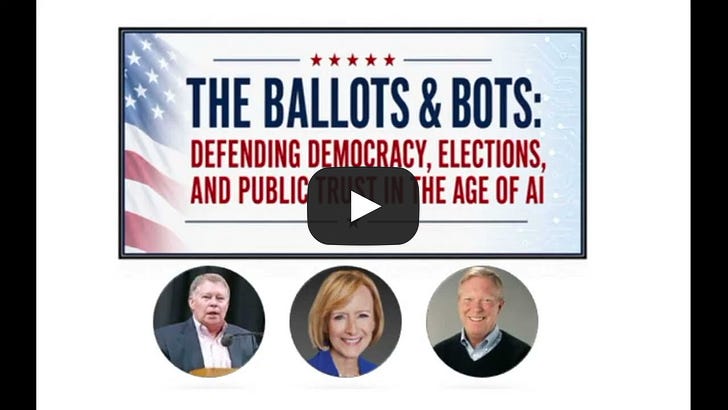
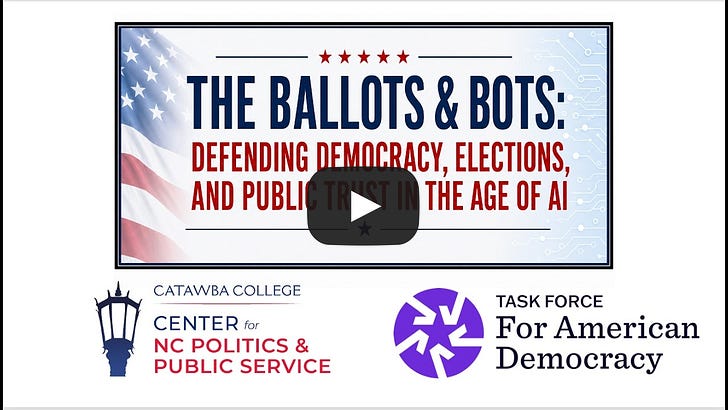
On September 28th, Catawba College’s Center for North Carolina Politics & Public Service co-presented a conference with the Task Force for American Democracy on “The Ballots & Bots: Defending Democracy, Elections, and Public Trust in the Age of AI.”
Two panels discussed the dynamics of how AI and other threats are challenging public trust in our elections from different perspectives—you can watch both panels on the Center’s YouTube Channel:
In addition, a community conversation was held that evening: