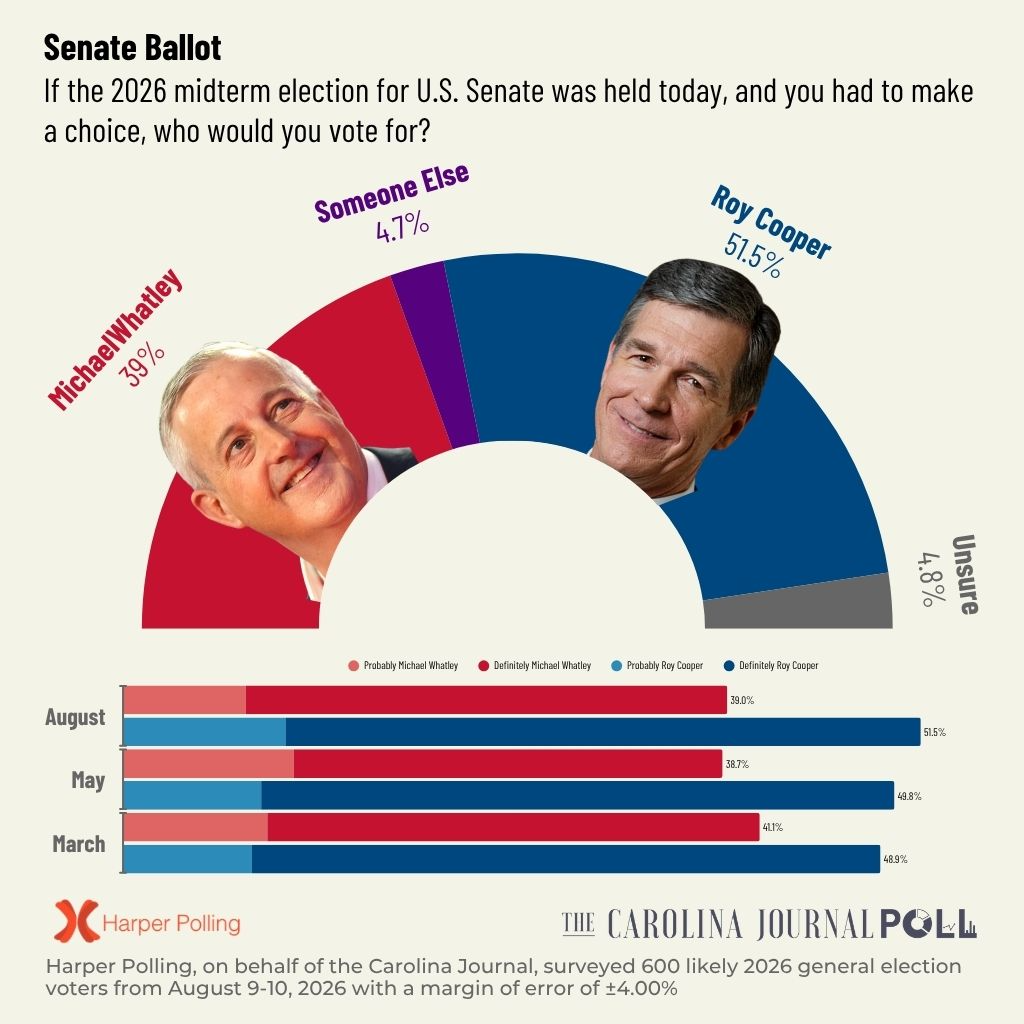
Democrat Roy Cooper now holds a 12.5-point lead over Republican Michael Whatley in the race for North Carolina’s open US Senate seat, according to the latest Carolina Journal Poll of 600 likely general election voters.
Support for Cooper, a former two-term governor, now stands at 51.5%, according to the poll conducted Aug. 9-10 by Harper Polling. Support for Whatley, a former state and national Republican Party chairman, stands at 39%. The poll has a ±4% margin of error.
Cooper led Whatley by 11.1 points when the CJ Poll asked likely general election voters about the Senate race in May. Support for Whatley increased by 0.3 points (from 38.7%) during the past three months, while support for Cooper grew by 1.7 points (from 49.8%). This is the first time Cooper has topped the 50% threshold since the CJ Poll started asking voters about the Cooper-Whatley contest.
“There’s little for the Whatley campaign to like about this poll,” said Donald Bryson, John Locke Foundation CEO and Carolina Journal publisher. “These numbers will almost certainly tighten once the campaign fully engages after Labor Day, but Whatley is starting the fall further behind than any Republican candidate would want. His overall support has barely moved since the spring, or even since last November, and Cooper currently has the stronger partisan coalition. Whatley gets 81% of Republicans, while 9% cross over to Cooper. By comparison, Cooper holds 91% of Democrats, with just 3% backing Whatley. Most concerning for Republicans, Cooper leads among independent voters by 55% to 34%. There is plenty of campaign left, but Whatley clearly has ground to make up.”
The race for a seat on North Carolina’s Supreme Court shows incumbent Democrat Anita Earls holding a 3.6-point lead over Republican challenger Sarah Stevens. While 43.3% of voters back Earls, 39.7% support Stevens. The race has tightened slightly since May, when Earls held a 5.7-point lead (41.3-35.6%).
Democrats continue to hold advantages when asked about voters’ support for the two major parties in both congressional (48.8-43.5%) and legislative (48-42.6%) races. The Democratic Party has seen an advantage in the “generic ballot” in each Carolina Journal Poll this year.
In addition to Election Day and mail-in balloting, voters can cast ballots this fall during 17 early voting days. A plurality (45.3%) of those surveyed support maintaining the same number of early voting days in the future. Some 7.3% support getting rid of early voting days entirely and 15.2% support cutting the current number, while 28.8% indicate they would support more early voting days.
More than two-thirds (67.3%) of those polled would support a state constitutional amendment to require all voters to present photo identification before voting, not just those who vote in person. About 30% of voters oppose that amendment.
A plurality (49.1%) say they would be less likely to vote for a candidate who identifies as a democratic socialist, including 43.6% who say they would be “much less likely” to support that candidate. Roughly a quarter (25.5%) of voters say they would be more likely to support a democratic socialist, including 15.1% who would be much more likely to support that candidate.
Asked to choose two of 12 options for the most important issues in the 2026 election, inflation and cost of living (43.3%), Social Security and Medicare (22.8%), healthcare (22.7%), and immigration (20.2%) topped the list.
North Carolina voters continue to take a more negative view of the nation’s direction. Just 34% indicated the United States is moving in the right direction. That’s down from 39.1% in May. Now 60.9% say they believe the nation is on the wrong track. That’s up from 57.7% in May.
President Donald Trump registers a 41.2% approval rating, compared to 56.7% disapproval. Those numbers have declined slightly since May, when presidential approval (41.5%) also trailed disapproval (56.6%) by roughly 15 points.
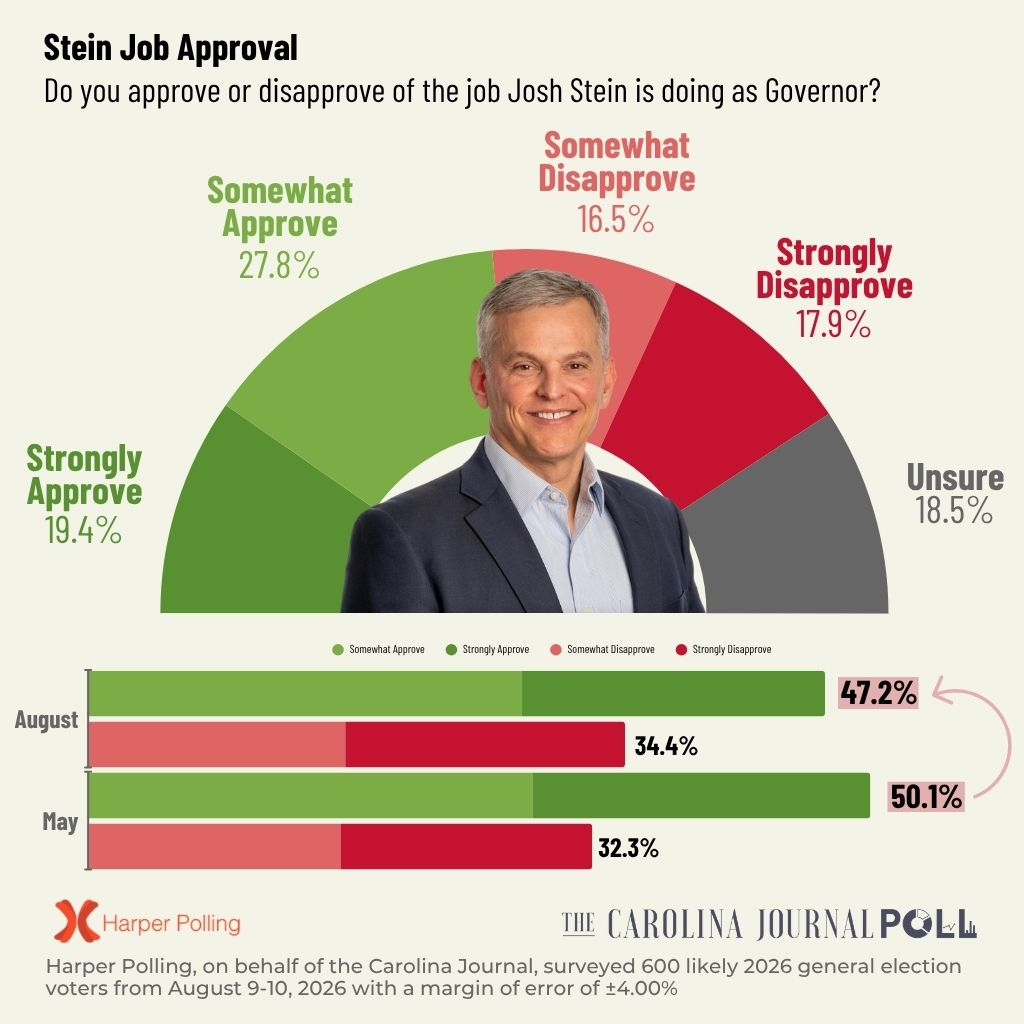
Gov. Josh Stein’s approval rating (47.2%) dipped below 50% for the first time this year, though his disapproval remains almost 13 points lower at 34.4%.
More than half of North Carolina’s 115 school boards are elected in partisan races, and voters are split on the idea of making all local school board elections partisans. While 34.6% of voters oppose the idea, 33.9% support it, and 31.6% say they are unsure.
As the Trump administration continues to pursue new tariffs, the CJ poll asked voters about two potential impacts of tariffs. Pollsters also asked similar questions about the impact of corporate income taxes.
About 40% of those surveyed agreed that both tariffs and corporate income taxes lead to lower worker wages. Some 34.2% said they didn’t believe tariffs led to lower wages, with 25.8% indicating they were unsure. For corporate taxes, 36.6% answered no on lowering wages, while 23.4% said they were unsure.
There was a little wider variation when people were asked about the impact of tariffs and corporate income taxes on consumer prices. While 80.9% of those surveyed agreed tariffs are passed on to consumers through higher prices, with just 8% answering no, 71.1% believed corporate income taxes contributed to higher prices, with 10.7% answering no.
“North Carolinians clearly understand that tariffs come with real economic costs,” Bryson said. “A plurality believe higher tariff costs for employers translate into lower wages for workers, while four out of five voters recognize that tariffs are ultimately passed along to consumers through higher prices. Those are numbers President Donald Trump and his advisers should keep in mind as they continue to pursue a tariff-heavy trade policy.”
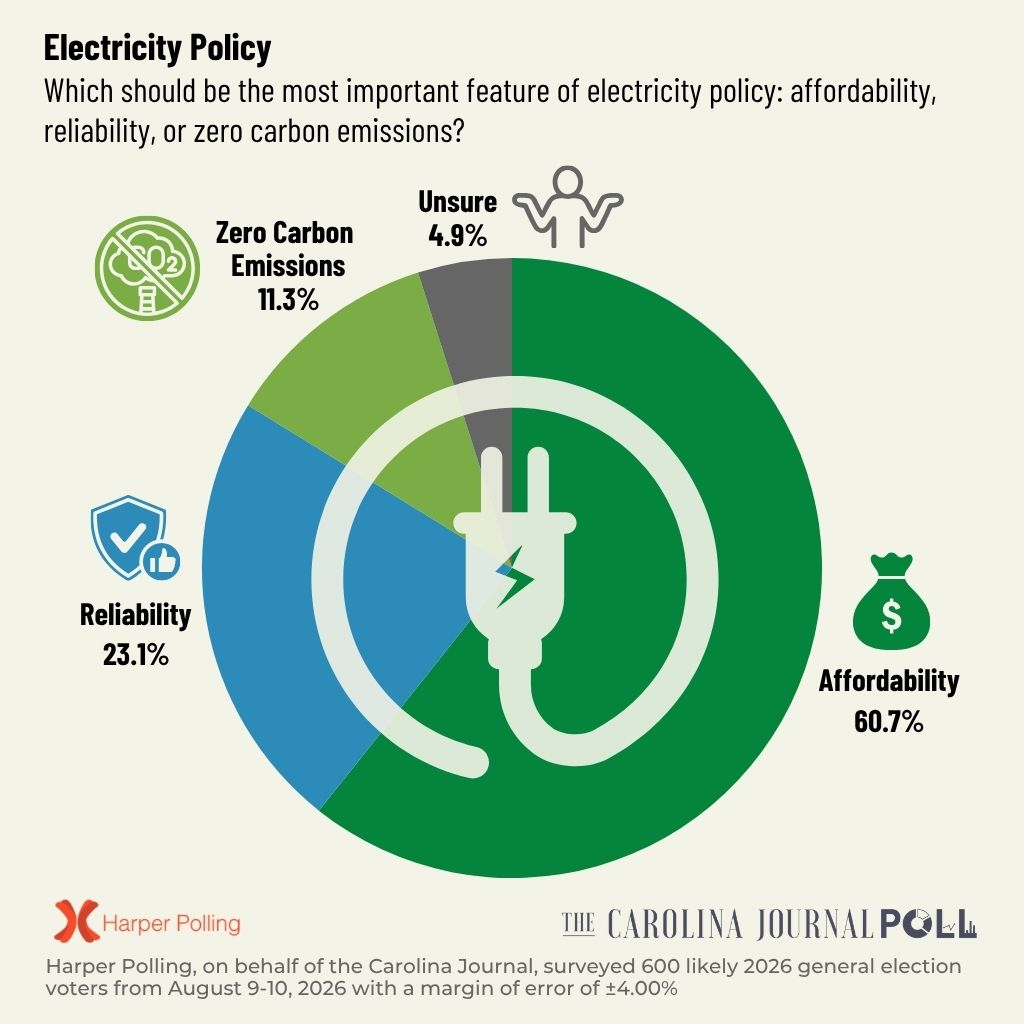
On policy issues, the CJ poll found that 60.7% of North Carolina voters believe affordability should be the most important feature of electricity policy, 47% believe state budget earmarks should be avoided (compared to 28.3% who support earmarks), and 86.5% believe state legislators who request earmarks should be identified in the budget document.
A plurality (37.7%) believe North Carolina needs less regulation of intoxicating cannabis-related products, 56% believe the state should use methods other than tolls to pay for highway construction and expansion, and a plurality (47%) believe the state should scrap its annual fee on electric vehicles for highway maintenance.
For questions, or to arrange an interview, please contact Brenée Goforth Swanzy, at bgoforth@carolinajournal.com