Former Democratic Gov. Roy Cooper maintains a wide lead over former Republican National Committee Chairman Michael Whatley in North Carolina’s closely watched US Senate race, but the gap between the two candidates has narrowed since September, according to the latest Carolina Journal Poll. Cooper leads Whatley by 10.3 points, with 49.4% of likely voters supporting Cooper and 39.1% supporting Whatley. The October results represent a 4.8-point narrowing of Cooper’s lead since September, when the former governor led Whatley by 15.1 points.
Whatley’s support increased by five points since September, when he received 34.1% of the vote. Cooper’s support remained relatively unchanged, increasing slightly from 49.2% to 49.4%. Meanwhile, the share of undecided voters dropped from 12.3% in September to 6.8% in October. Libertarian candidate Shannon Bray received 2.9% support, while Green Party candidate Michael Dublin received 1.9%.
This month’s poll also included a hypothetical head-to-head Cooper-Whatley matchup, which excluded third-party candidates. In this hypothetical race, Cooper received 51.6% support compared to Whatley’s 42%, with 6.5% of voters undecided.
Whatley’s favorability rating has improved from last month; however, he is still underwater. A third of likely voters (33.4%) shared a favorable opinion of Whatley, up seven points from September. His unfavorable rating declined from 42.0% to 38.7%. The share of voters who have never heard of Whatley also declined, from 18.3% in September to 12.0% in October. Another 15.9% have no opinion of the Republican candidate, meaning more than a quarter of likely voters (27.9%) still either have no opinion of Whatley or have never heard of him.
Cooper’s favorability rating also improved, with a majority of likely voters (52.2%) holding a favorable opinion of the former governor, compared to 47.1% in September. Another 41.1% view Cooper unfavorably, down from 43.1% last month. Only 6.7% of voters have no opinion of Cooper or have never heard of him.
“With Election Day approaching, North Carolina’s Senate race is tightening, and voters are becoming more familiar with the candidates,” said Donna King, executive vice president of the John Locke Foundation and publisher of Carolina Journal. “While Whatley’s gains in both ballot support and name recognition are noteworthy, Cooper continues to maintain a substantial lead.”
In the race for the North Carolina Supreme Court, Democratic incumbent Anita Earls leads Republican Sarah Stevens by 7.6 points. Earls received 47.3% support compared to Stevens’ 39.7%, with 13.0% of voters undecided. Earls’ support remained nearly unchanged from September, when she received 47.2%, while Stevens’ support increased from 36.4%.
Democratic candidates also maintain an advantage over Republicans in both state legislative and congressional races. On the generic ballot for the North Carolina General Assembly, a plurality of likely voters (48.5%) expressed support for Democratic candidates, compared to 42.7% who expressed support for Republican candidates. Another 8.8% remain undecided. The 5.8-point Democratic advantage is narrower than September’s 8.2-point lead, when Democrats received 49.5% support and Republicans received 41.3%.
Similarly, on the generic congressional ballot, Democrats lead Republicans by 5.9 points, with 49.1% supporting Democratic candidates and 43.2% supporting Republican candidates. Another 7.7% are undecided. In September, Democrats held a 9.2-point advantage on the congressional ballot.
Support for Democratic candidates also did not extend to support for the Democratic Socialists of America. Nearly half of likely voters (45.9%) hold an unfavorable opinion of the organization, including 42.4% who view it very unfavorably. About a quarter of voters (24.1%) have a favorable opinion of the organization. Approval for the DSA is heavily correlated to age, with a favorable view being expressed by 39% of voters aged 18-34, 27% of those aged 35-49, 22% of those aged 50-64 years, and 17% of those 65 years or older.
Despite Democrats leading on the generic state legislative ballot, a plurality of voters (46%) said they believe Republicans should control the General Assembly to provide a check on Democratic Gov. Josh Stein and his agenda. Conversely, 41.2% said Democrats should control the legislature to help support the governor’s agenda, while 12.8% remain unsure.
The poll also asked voters whether their preferred political candidates had changed over the past six months. More than three-quarters of likely voters (76.2%) said their preferences had not changed, while 18.1% reported changing their preferences and 5.7% were unsure. Among all respondents, 6.1% said they had moved from undecided to supporting Republican candidates, while 5.3% moved from undecided to supporting Democratic candidates. Another 3.7% switched from Democratic to Republican candidates, while 3.0% switched from Republican to Democratic candidates.
A majority of North Carolina likely voters (54.5%) disapprove of President Donald Trump’s job performance, while 43.9% approve. Trump’s approval rating increased by 2.8 points since September, when 41.1% approved his job performance. His disapproval rating declined from 57.1% to 54.5%. Nearly half of voters (49.2%) strongly disapprove of Trump’s performance, while 27.1% strongly approve.
Meanwhile, Gov. Josh Stein receives majority approval among North Carolina likely voters. A narrow majority (50.5%) approve of Stein’s job performance, compared to 32.2% who disapprove. Another 17.2% remain unsure. Stein’s approval rating increased slightly from 49.4% in September, while his disapproval rating declined from 32.9%.
A majority of voters (57.5%) believe the United States is headed in the wrong direction, compared to 37.2% who believe the country is headed in the right direction. The results represent a modest improvement in perceptions of the country’s direction since September, when 61.5% believed the country was on the wrong track and 33.4% believed it was headed in the right direction.
When asked to identify the single most important issue in the 2026 election, a plurality of likely voters (31.8%) selected inflation and the cost of living. The economy and jobs ranked second at 11.4%, followed by Social Security and Medicare (9.2%), immigration (7.9%), and national security (7.2%). Other concerns included taxes and spending (6.9%), health care (6.7%), crime and public safety (6.0%), education (3.1%), climate change (3%), energy and utility costs (2.2%), and gas prices (1.6%).
This poll also examined voters’ attitudes toward North Carolina’s temporary suspension of the state gas tax. An overwhelming majority of likely voters (71.9%) said they were aware that the General Assembly had suspended state gas taxes through the end of November, using reserve funds to stabilize transportation funding, and that Gov. Stein had signed the measure into law. Another 22.3% were unaware of the suspension, while 5.9% were unsure.
When asked whether they support or oppose suspending the gas tax in this manner, more than two-thirds of voters (70.2%) expressed support, including 38.7% who strongly support the measure and 31.4% who somewhat support it. Only 16.3% oppose the suspension, including 9.2% who somewhat oppose it and 7.1% who strongly oppose it. Another 13.5% remain unsure.
The poll also found majority support for three proposed constitutional amendments addressing property taxes, income taxes, and voter identification. A majority of likely voters (59.6%) support a constitutional amendment requiring limits on property tax increases by local governments. Another 29.8% oppose the amendment, while 10.6% remain unsure. Support declined by six percentage points since September, when 65.6% favored the amendment. Opposition increased from 21.2% to 29.8%.
A majority of voters (64.3%) also support a constitutional amendment preventing North Carolina’s state income tax rate from being raised above 3.5%, compared to 26.8% who oppose it and 8.9% who remain unsure. Half of voters (50%) strongly support the income tax amendment, while another 14.3% somewhat support it. Overall support declined slightly from 66.9% in September.
The strongest support among the three amendments was for requiring photo identification from all voters, including those voting absentee by mail. Nearly two-thirds of likely voters (65.1%) support a constitutional amendment requiring all voters, not just those voting in person, to present photo identification before voting. Another 31.1% oppose the measure, while 3.8% remain unsure. More than half of voters (55.6%) strongly support the voter identification amendment, compared to 22.5% who strongly oppose it. Support for the amendment remained relatively stable from September, when 66.4% supported the proposal.
“North Carolina voters continue to express majority support for all three constitutional amendments, even as support for some has softened since September,” said King. “Despite voter ID being one of the most contentious issues in the media, it has the greatest support among North Carolinians.”
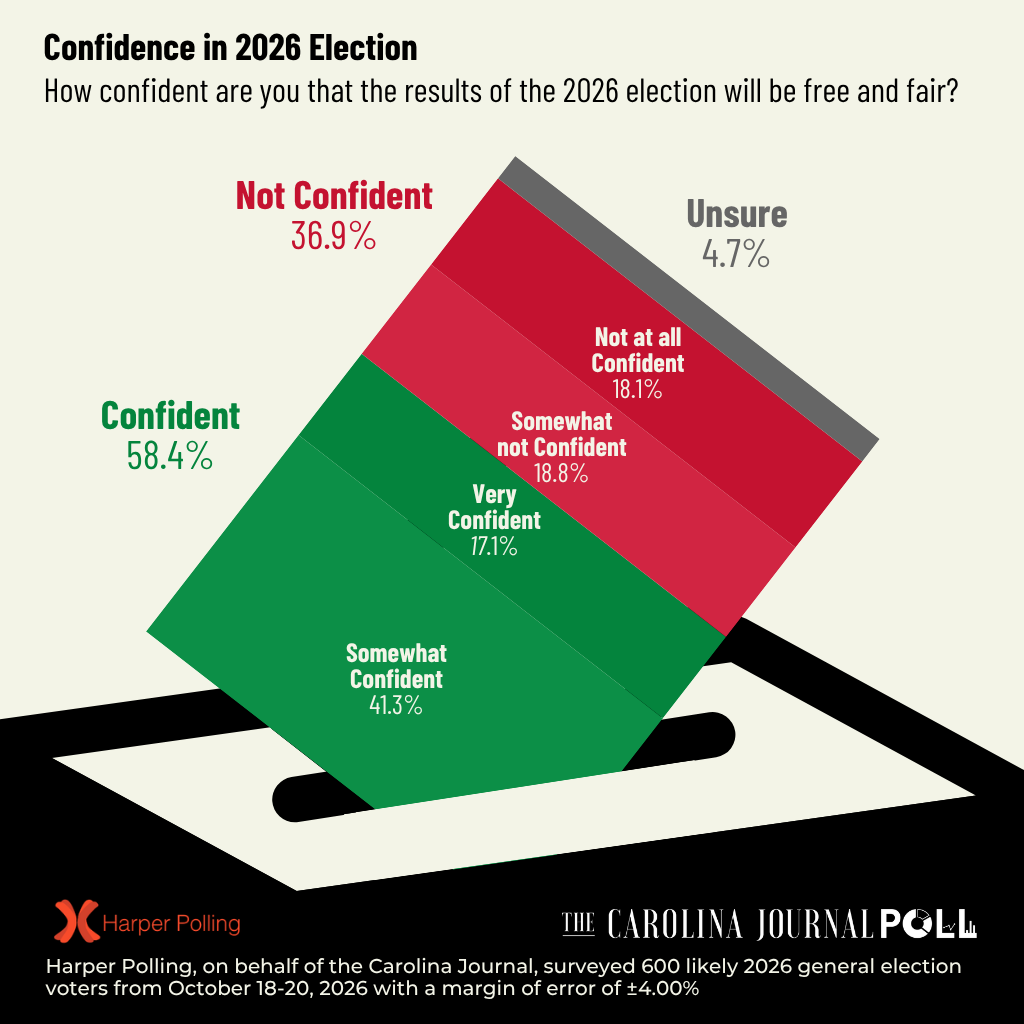
With voting already underway, the poll also asked likely voters how confident they are that the results of the 2026 election will be free and fair. A majority of voters (58.4%) expressed confidence in the election results, including 17.1% who are very confident and 41.3% who are somewhat confident. More than a third of voters (36.9%) said they are not confident, including 18.8% who are somewhat unconfident and 18.1% who are not at all confident. Another 4.7% remain unsure.
Voter confidence is noticeably lower than when voters were polled after the 2024 General Election. In November 2024, 69% of voters were confident that the election had been free and fair, and only 25.5% were not confident. Voter confidence has declined 35 points among Republicans, with 85% of GOP voters expressing confidence in November 2024, compared to 56% in October 2026. On the contrary, voter confidence among Democratic voters has increased by 10 points, with 50% of Democrats expressing confidence in free and fair election in 2024, compared to 60% now.
The poll also examined attitudes toward paid political endorsements on social media. An overwhelming majority of likely voters (83.4%) believe social media personalities should be required to disclose when they are paid to support a political candidate. Only 8.9% oppose requiring such disclosures, while 7.7% remain unsure. Current guidance from the NC State Board of Elections does not require this disclosure.
The poll also examined access to primary health care among North Carolina likely voters. More than four-fifths of voters (81.3%) said they regularly see a primary health care provider, while 17.0% said they do not. Among all respondents, 7.3% said they do not regularly see a primary health care provider because they cannot afford the cost, while 4.0% reported difficulty finding a provider or obtaining an appointment. Another 5.6% said they choose not to see a primary health care provider because they have no health concerns.