HPU Poll finds most North Carolina adults recognize breast cancer awareness month
Published 6:49 p.m. today
A new High Point University® Poll finds that most North Carolina adults are aware October is Breast Cancer Awareness Month. Nearly three-quarters (74%) said they were aware of the observance, while 22% said they were not aware.
North Carolinians reported relatively high familiarity with breast cancer compared with other cancers included in the survey. Thirty-six percent said they know a lot about breast cancer and another 44% said they know a little, while 20% said they know not much at all. Breast cancer had the largest share saying they know a lot among the eight cancer types tested.
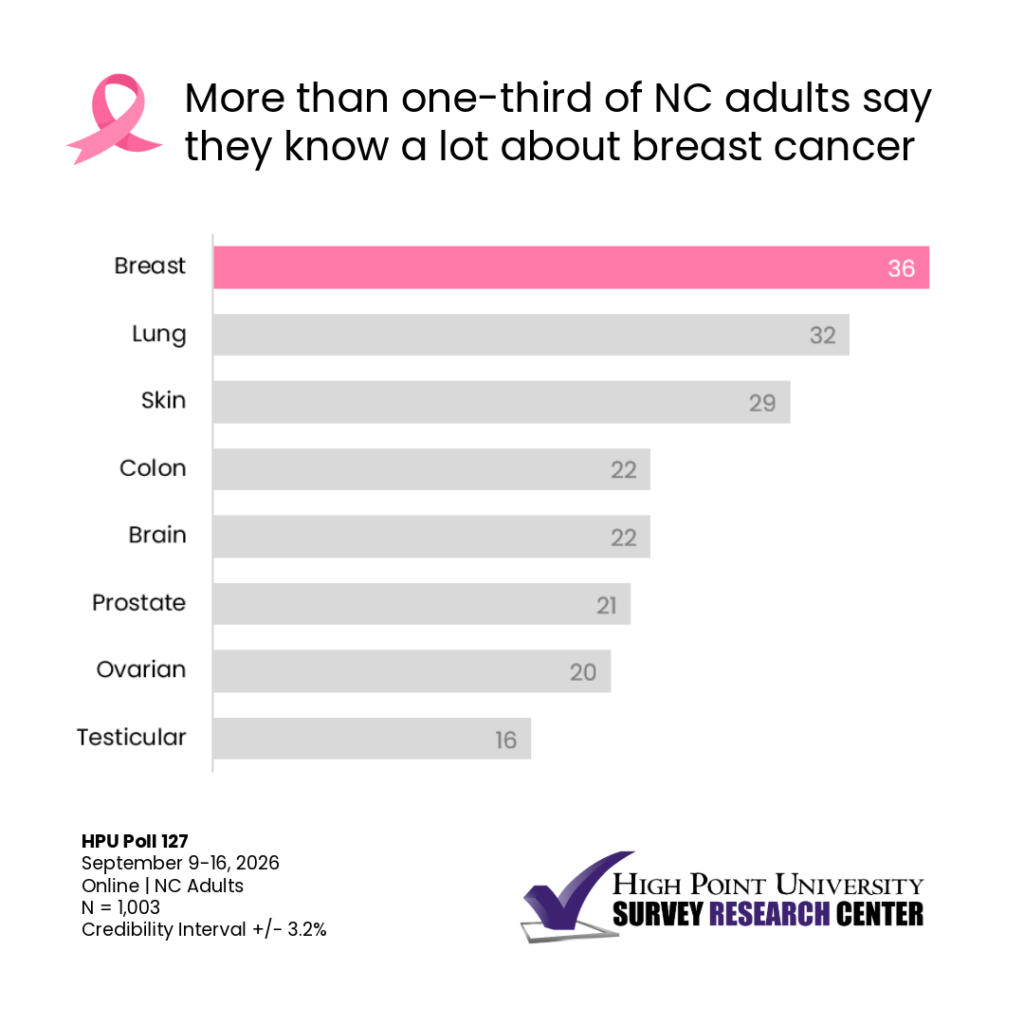
For comparison, 32% of North Carolinians said they know a lot about lung cancer, 29% about skin cancer, 22% each about brain and colon cancer, 21% about prostate cancer, 20% about ovarian cancer and 16% about testicular cancer.
The poll also asked several factual items about cancer. When asked which cancer is the No. 1 cancer killer of men, 54% selected prostate cancer, 24% selected lung cancer, 16% selected colon cancer and 7% selected testicular cancer. The correct answer is lung cancer (which is the top lethal cancer for both men and women.)
When asked which cancer is the No. 1 cancer killer of women, 62% selected breast cancer, while 17% each selected lung cancer and ovarian cancer and 4% selected colon cancer.
Respondents were also asked which cancer receives the most National Cancer Institute research funding. A majority (54%) selected breast cancer, followed by lung cancer at 29%, colon cancer at 11% and prostate cancer at 7%. The correct response is breast cancer. So, a majority of respondents answered correctly.
Cancer has touched many North Carolina adults personally or through someone close to them. Six percent said they themselves had been diagnosed with cancer, 47% said someone close to them had been diagnosed, and 5% said both they and at least one person close to them had been diagnosed.
Dr. Lorrie R. Davis-Dick, assistant professor at the HPU Teresa B. Caine School of Nursing, explained that “greater public awareness and improved access to healthcare services may be contributing to more breast cancers being detected through screening and early diagnosis.”
Forty-one percent said neither they nor someone close to them had been diagnosed with cancer, and 2% preferred not to respond.
North Carolina Residents – Cancer Knowledge (September 2026)
Here is a list of different types of cancer. For each one, please select whether you think you know a lot, a little, or not much at all about that type of cancer. (Respondents were presented with the cancers in a randomized order)
Lung — A lot 32%; A little 45%; Not much at all 23%
Brain — A lot 22%; A little 44%; Not much at all 35%
Prostate — A lot 21%; A little 48%; Not much at all 31%
Skin — A lot 29%; A little 49%; Not much at all 22%
Colon — A lot 22%; A little 47%; Not much at all 32%
Ovarian — A lot 20%; A little 45%; Not much at all 36%
Testicular — A lot 16%; A little 42%; Not much at all 42%
Breast — A lot 36%; A little 44%; Not much at all 20%
North Carolina Residents – Most Common Cancer Killer for Men (September 2026)
Now we would like you to respond to some factual items about cancer. Please select the correct response to each item. Later in the survey we will provide the correct answers to you.
__________ cancer is the #1 cancer killer of men. (Indicate which type of cancer should be in the blank.) (The list of responses was randomized)
Prostate — 54%
Colon — 16%
Lung — 24%
Testicular — 7%
Correct response: Lung cancer
North Carolina Residents – Most Common Cancer Killer for Women (September 2026)
__________ cancer is the #1 cancer killer of women. (Indicate which type of cancer should be in the blank.) (The list of responses was randomized)
Breast — 62%
Colon — 4%
Lung — 17%
Ovarian — 17%
Correct response: Lung cancer
North Carolina Residents – Most Cancer Research Funding (September 2026)
__________ cancer receives the most National Cancer Institute research funding. (Indicate which type of cancer should be in the blank.)
Breast — 54%
Colon — 11%
Lung — 29%
Prostate — 7%
Correct response: Breast cancer
North Carolina Residents – Cancer Diagnosis (September 2026)
Have you or someone close to you been diagnosed with cancer(s)? (Note: We do not have any information about your identity apart from what you record on this survey)
Yes, me — 6%
Yes, someone close to me — 47%
Yes, both me and at least one person close to me — 5%
No — 41%
Prefer not to respond — 2%
North Carolina Residents – Breast Cancer Awareness Month (September 2026)
Are you aware that October is Breast Cancer Awareness month?
Yes — 74%
No — 22%
Unsure — 4%
Methodology:
HPU Poll 127 was fielded by the High Point University® Survey Research Center (SRC) from Sept. 9 through Sept. 16, as an online survey using a panel of respondents recruited and maintained by Dynata. Dynata sent invitations to its panel of North Carolina respondents, and the SRC collected 1,003 responses from adults age 18 and older living in North Carolina using its Qualtrics platform. All interviews were conducted in English.
The SRC conducted all data analysis. The online sample is from a non-probability panel of respondents, so it is not appropriate to assign a classic margin of sampling error to the results. For the full all-adults sample (n = 1,003), the SRC provides a credibility interval of plus or minus 3.2 percentage points to account for a traditional 95% confidence interval for the estimates (plus or minus 3.1 percentage points) and a design effect of 1.1 based on the weighting.
High Point University’s SRC worked with Dynata to fill quotas for age, gender, race and ethnicity based on estimates within the North Carolina adult population derived from U.S. Census reports. The all-adults data is weighted toward population parameters for age, gender, race, education and ethnicity published by the U.S. Census for North Carolina. The High Point University Survey Research Center produces weights through an iterative procedure within SPSS. Weights are based on demographic variables. Factors such as question wording and other methodological choices in conducting survey research can introduce additional error into the findings of opinion polls.
HPU Polls include at least one CAPTCHA and reCAPTCHA for screening out non-human respondents in addition to the screening done by Dynata. To enhance data quality, the survey included two response quality items that screened out respondents who did not answer them correctly.
The HPU SRC drafted the survey instrument, which was approved by the HPU Institutional Review Board. Interviews were collected through the High Point University®SRC, recording responses in Qualtrics. Dynata’s online panels invited respondents. Respondents were compensated according to their agreements with Dynata.
The HPU SRC did not use AI for generating responses, interviewing, cleaning data, producing estimates or coding/labeling data.
Further results and methodological details from the most recent survey and past surveys can be found at the Survey Research Center website. Materials online include past press releases as well as memos summarizing the findings for each poll since 2010.
The HPU Poll reports methodological details in accordance with the standards set out by AAPOR’s Transparency Initiative, and the HPU Survey Research Center is a Charter Member of the Initiative.
Dr. Martin Kifer, chair and professor of political science, serves as executive director of the HPU Poll for the Survey Research Center. Dr. J.R. Moller serves as staff director of the HPU Poll for the Survey Research Center. Tiffany Medford serves as program coordinator for the Survey Research Center.