NC’s economic success depends on better workforce alignment
Published July 30, 2026
Earlier this month, CNBC announced that North Carolina is the No. 1 state for the economy, the No. 2 state for business, and the No. 3 state for workforce. Gov. Josh Stein said he was “proud that we announced a record-breaking number of jobs in 2025, expanding opportunity to every corner of the state.”
That’s great news for North Carolinians. But one challenge resulting from this continued good performance and growth is that now employers have trouble finding skilled workers to fill open positions. According to the North Carolina Department of Commerce, 62% of employers report difficulty hiring workers. North Carolina’s workforce is highly skilled — but not necessarily in the right areas.
A new report from the James G. Martin Center for Academic Renewal, “Aligning Education with Work: Why Employer Partnerships Are the Key to Effective Workforce Education in North Carolina,” examines workforce misalignment in the state and offers policy solutions.
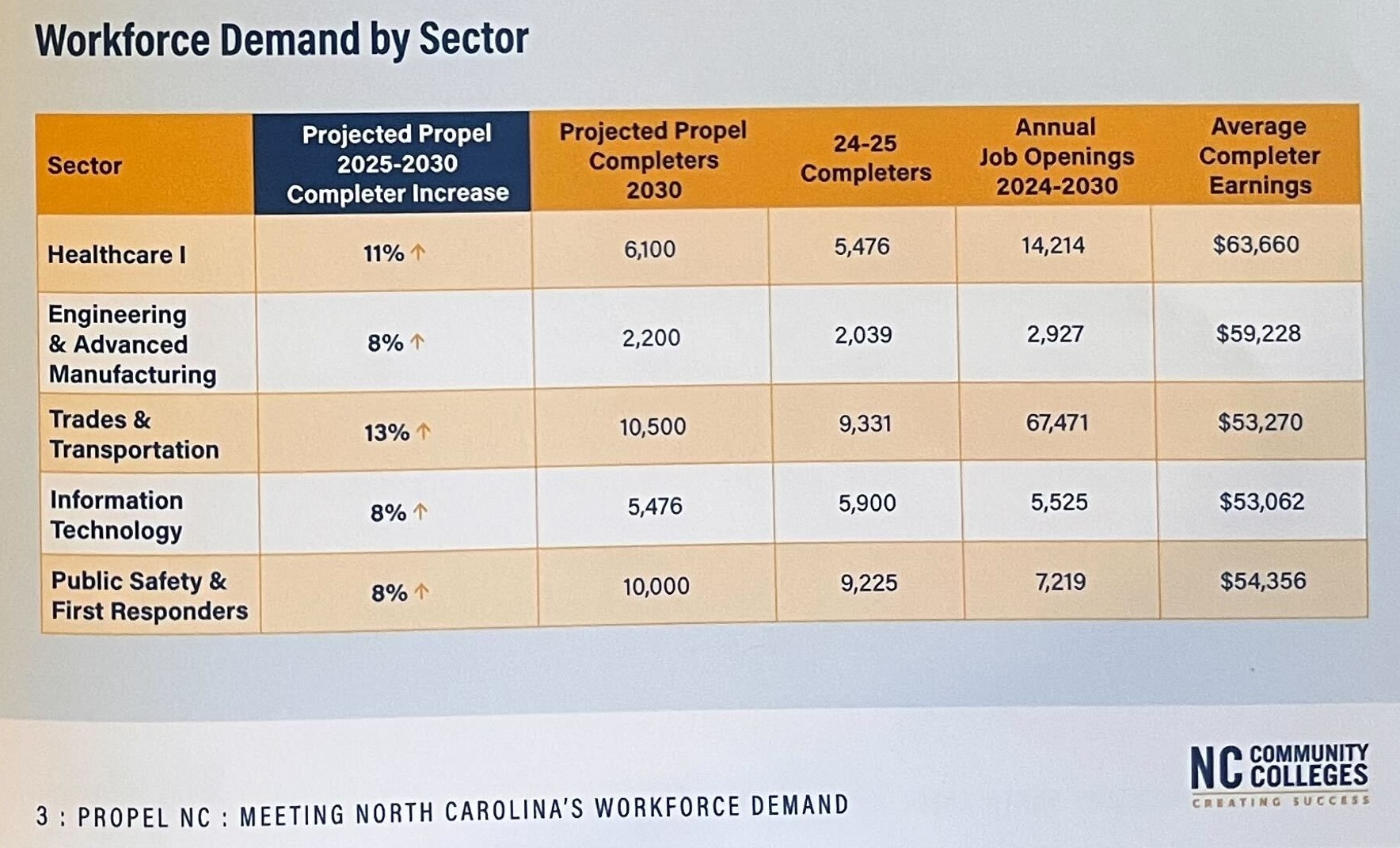
The problem confronting many North Carolina employers is that too many young people graduate from institutions of higher education with credentials that don’t match those needed in the industries that are growing and hiring the fastest. A report by the UNC System reveals that North Carolina is “undersupplied” in business, computer science, education, engineering, and health professions. A similar report from the North Carolina Community College System says the same about healthcare and nursing, advanced manufacturing, engineering, trades and transportation, and information technology. The challenge will only become more acute as North Carolina’s population ages and fewer young workers enter the labor force.
The Martin Center’s report exposes an important weakness in North Carolina’s approach to workforce readiness: employers are only rarely involved. But when employers are part of the process, outcomes improve. Employers know which skills they need, allowing curricula to adjust more quickly than traditional academic planning often permits. Evidence shows that apprenticeships, internships, and other forms of work-based learning all yield benefits for both students and employers. Research shows that apprentices are 13% more likely to be employed a decade after completion of the program and will also earn more money.
Employers benefit as well, reducing recruiting costs while building customized talent pipelines. The Martin Center cites several successful examples of employer partnerships in the state, including the Carolina Battery Institute, the Golden LEAF Biomanufacturing Training & Education Center at NC State, Wake Tech’s Biomechatronics Apprenticeship, Novant Health’s Future Forward program, and NC BioImpact.
NC lawmakers recently took one important step to begin closing the workforce gap, at least for short-term credentials and associate’s degrees. Propel NC, a new workforce-driven funding model that ties community college funding to student enrollment in programs aligned with high-demand, high-wage fields, was funded as part of the newly approved North Carolina budget.
In addition to full implementation of Propel NC, the Martin Center recommends four key reforms to address this problem: alignment of funding and incentives, increased transparency, increased regulatory flexibility, and support for work-based learning. This includes a significant role for employer partnerships.
Specifically, the report recommends that North Carolina take recently proposed Ohio legislation as its model. Ohio’s Senate Bill 462, the Joining-Opportunities Businesses and Schools (JOBS) Act, “creates Qualified Education Partnerships…between accredited Institutions of Higher Education (IHEs) and private sector employers.” According to the Martin Center, the bill “ incentivizes public-private partnerships and rewards excellence in delivery.” Such a bill could help North Carolina students and employers by creating better workforce alignment.
For North Carolina to remain a great state for business, workforce education must change. Colleges and universities should rely on markets and employers — the drivers of our vibrant economy — to improve workforce alignment going forward.
Jenna Robinson is president of the James G. Martin Center for Academic Renewal.