North Carolinians united on Declaration of Independence, divided on whether America fulfills Its ideals
Published July 1, 2026
As the nation prepares to commemorate the 250th anniversary of the Declaration of Independence, overwhelming majorities of North Carolinians say it is important to celebrate the nation’s founding document and that its ideals remain important. Yet most also believe the United States has not fully lived up to those ideals, according to a new Catawba College–YouGov Survey.
Of the 1,000 weighted respondents, North Carolinians overwhelmingly agree on the importance of its core ideals. More than eight in ten respondents (84 percent) said the principles expressed in the Declaration remain either extremely important (56 percent) or very important (28 percent) today.
With the holiday coming up, 87 percent believe it is important to celebrate the Declaration, with agreement across the partisan spectrum. Eight out of ten Democrats believe it is important, along with 86 percent of Independents. Republicans are nearly unanimous, with 98 percent saying it is important.
“North Carolinians clearly believe the Declaration of Independence remains central to the nation’s identity,” said Dr. Michael Bitzer, professor of politics and history and director of the Center for North Carolina Politics & Public Service, which commissioned the survey. “What’s especially striking is that agreement extends beyond the importance of celebrating the document itself to the enduring relevance of its core principles.”
This view of the Declaration’s core principles was shared broadly across partisan groups, including 80 percent of Democrats, 85 percent of Independents, and 88 percent of Republicans.
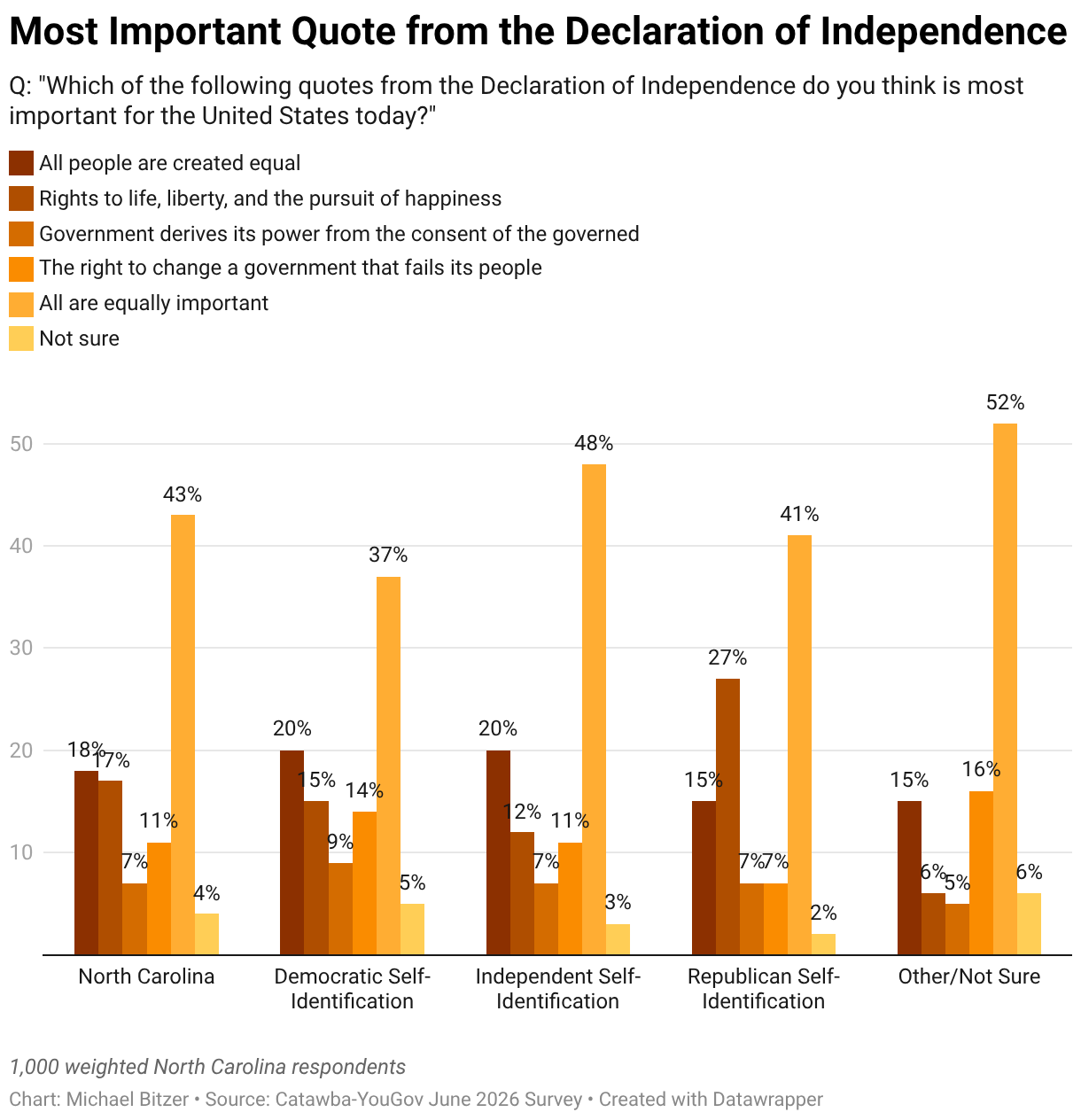
When given four key quotes from the document, 43 percent of North Carolinians said all were equally important. Nearly two in ten (18 percent) said ‘all people are created equal,’ while a similar percentage (17) said ‘the right to life, liberty, and pursuit of happiness’ was important. One in ten said the right to change a government that fails its people was most important, while only 7 percent selected the phrase ‘government derives its power from the consent of the governed’ as most important.
“Rather than elevating a single principle, a plurality of North Carolinians said the Declaration’s major ideas—including equality, liberty, popular sovereignty, and the right to reform government—are equally important,” Bitzer noted.
However, secondary choices reveal meaningful partisan differences among North Carolinians. While 37 percent of Democrats selected all the phrases as important, their second highest phrase (20 percent) was ‘all persons are created equally.’ Among Republicans, while 41 percent selected all, the second most important to them was ‘right to life, liberty, and the pursuit of happiness,’ at 27 percent.
North Carolinians were asked about the Declaration of Independence’s ideals today, and a plurality—38 percent—said it is ‘a foundational statement of enduring American ideals.’ Only seven percent of North Carolinians believe the Declaration reflects ideals the nation has fully achieved, suggesting that most respondents view the document as both a statement of principle and an ongoing challenge for the country.
“While there’s agreement on the Declaration’s principles, it does not necessarily translate into agreement about the nation’s progress toward achieving them,” Bitzer observed.
“What stands out is that North Carolinians largely agree on the ideals themselves,” Bitzer said. “That distinction helps explain both the enduring power of the Declaration and the continuing debates over what it means in modern America. As the nation approaches its 250th anniversary, North Carolinians appear to agree on the ideals themselves even as they disagree on how fully those ideals have been realized.”
The online survey was conducted by YouGov of 1,000 weighted North Carolinians from June 1 to 10, 2026, and has an overall margin of error of +/-3.83 percent; subgroups will have a higher margin of error. All survey results should be viewed as informative and not determinative; find out more information on the survey’s methodology here, with cross-tab analysis found here.
This is the second release of findings from the June 2026 Catawba College-YouGov Survey of 1,000 weighted North Carolinians. Future releases will focus on North Carolinians’ perspective about affordability and the mid-term election, along with the issue of political violence as the state and nation head into the general campaign towards November.
The online survey was conducted by YouGov of 1,000 weighted North Carolinians from June 1 to 10, 2026, and has an overall margin of error of +/-3.83 percent; subgroups will have a higher margin of error. All survey results should be viewed as informative and not determinative; find out more information on the survey’s methodology here, with cross-tab analysis found here.
“What stands out is that North Carolinians largely agree on the ideals themselves,” Bitzer said. “That distinction helps explain both the enduring power of the Declaration and the continuing debates over what it means in modern America. As the nation approaches its 250th anniversary, North Carolinians appear to agree on the ideals themselves even as they disagree on how fully those ideals have been realized.”
The starkest partisan difference emerged when respondents were asked whether the nation is living up to the Declaration’s ideals. Overall, 40 percent said the country is close to fulfilling those ideals, while 55 percent said it is not. That 15-point deficit masks a sharp partisan split: six in ten Democrats said the nation is not close to achieving the Declaration’s ideals, while 58 percent of Republicans said the nation is close to fulfilling them.
The online survey was conducted by YouGov of 1,000 weighted North Carolinians from June 1 to 10, 2026, and has an overall margin of error of +/-3.83 percent; subgroups will have a higher margin of error. All survey results should be viewed as informative and not determinative; find out more information on the survey’s methodology here, with cross-tab analysis found here.
This is the second release of findings from the June 2026 Catawba College-YouGov Survey of 1,000 weighted North Carolinians. Future releases will focus on North Carolinians’ perspective about affordability and the mid-term election, along with the issue of political violence as the state and nation head into the general campaign towards November.