North Carolina voters have mixed reactions to the results of the 2026 midterm elections, with a majority expressing dissatisfaction with the new makeup of the North Carolina General Assembly, yet expressing greater optimism about Democratic control of Congress, according to the latest Carolina Journal Poll. The post-election survey also found that voters are increasingly dissatisfied with the direction of the country, even as attitudes toward North Carolina’s direction have improved.
A majority of voters (60.6%) said they were not pleased with the election results that gave Democrats control of the North Carolina House and Republicans control of the state Senate. About a quarter of voters (25.6%) said they would prefer Democrats to control both chambers, while 23% would prefer Republicans to control both chambers. Another 12% expressed concern that divided control could lead to gridlock.
Less than a quarter of voters (24.2%) said they were pleased with the divided legislature, including 14.2% who believe divided control provides checks and balances and 10.1% who believe it encourages bipartisan compromise. Another 12.4% were neither pleased nor disappointed, while 2.8% were unsure.
At the federal level, a majority of voters (54.7%) said Democratic control of both chambers of Congress made them more optimistic about the country’s future, including 35.1% who were much more optimistic and 19.6% who were somewhat more optimistic. More than a third (37.5%) said the election results made them more pessimistic, while 6.3% said the results made them neither more optimistic nor more pessimistic, and 1.5% were unsure.
Despite that optimism, a majority of voters (60.3%) believe the United States is headed in the wrong direction, compared to 33.7% who believe the country is headed in the right direction. The share of voters who believe the country is on the wrong track increased by 2.8 points since October, while those who believe the country is headed in the right direction declined by 3.5 points. Another 5.9% remain unsure.
North Carolinians expressed somewhat more positive attitudes toward the direction of their own state. Nearly half of voters (49.7%) believe North Carolina is headed in the wrong direction, compared to 40% who believe the state is headed in the right direction. Another 10.3% remain unsure. The results represent an improvement from May, when 53.5% believed the state was on the wrong track and only 33.5% believed it was headed in the right direction.
“North Carolina voters are sending a complex message following the midterm elections,” said Donna King, executive vice president of the John Locke Foundation and publisher of Carolina Journal. “While voters remain concerned about the direction of the country as a whole, they’re expressing greater optimism about the direction of North Carolina. The results also demonstrate that voters are looking for more than a change in political leadership. They want accountability, effective governance, and solutions to the issues affecting their everyday lives.”
Some political pundits have speculated that the results of this year’s midterm reflect a voter revolt against inflation. Others have said the election results reflect a protest against the Trump administration. This poll found support for both of those theories. When asked to identify the leading issue motivating their vote, a plurality of voters (32.3%) selected corruption, followed by inflation and the cost of living (24.3%) and immigration (11.5%). Other concerns included the economy and jobs (8.5%), taxes and spending (5.4%), Social Security and Medicare (4.2%), crime and public safety (4.2%), health care (3.9%), education (1.1%), gas prices (1.1%), and climate change (0.3%).
When asked why they participated in the election, a plurality of voters (29%) said voting is a civic responsibility, regardless of the candidates. Another 23.9% said they voted to support candidates they believed would do a good job, while 14.8% said they voted to express opposition to President Donald Trump. Supporting the Republican Party motivated 12.2% of voters, compared to 7.7% who voted to support the Democratic Party. Another 5.4% said they voted to prevent candidates they opposed from winning, while 5% voted to express support for Trump and 2% selected another reason.
Honesty and integrity were the most important candidate qualities for a plurality of voters (29.3%), followed by whether a candidate cares about people like them (14.8%), experience and qualifications (13.9%), and governing philosophy (13.5%). Political party affiliation was the most important consideration for 9.4% of voters, while 8.8% selected leadership ability. Smaller shares identified faith (3.7%), independence from party leaders (1.5%), or another quality (3.5%), while 1.5% were unsure.
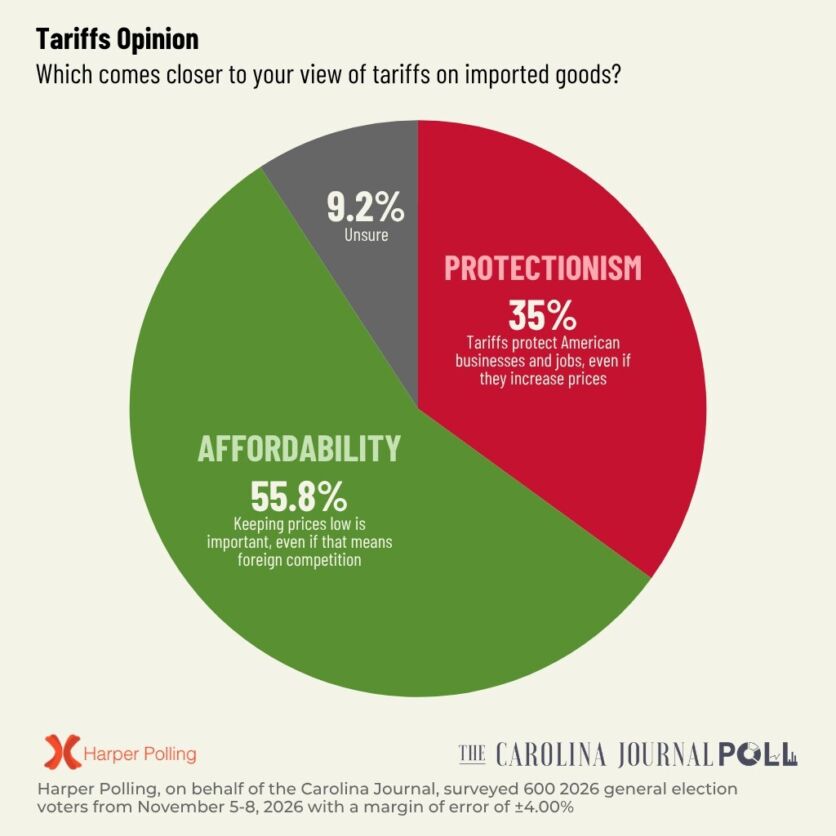
Economic concerns were also prominent throughout the poll, particularly regarding tariffs and their impact on consumer prices. A majority of voters (55.8%) said keeping consumer prices low is more important than using tariffs to protect American businesses and jobs, even if that means allowing more foreign competition. More than a third (35%) said tariffs are worth using to protect American businesses and jobs, even if they increase consumer prices. Another 9.2% were unsure.
When asked about the impact of federal tariffs on North Carolina’s cost of living, two-thirds of voters (66.7%) said tariffs have made living expenses higher. Another 25.6% believe tariffs have made little or no difference, while only 1.4% said tariffs have lowered the cost of living. The remaining 6.3% were unsure. A majority of voters (69.5%) also believe tariffs hurt Republicans in the 2026 midterm elections, compared to 18.5% who do not believe tariffs hurt the party and 12.1% who were unsure.
When asked which factor they believe is contributing most to increasing consumer prices, a plurality of voters (31.8%) selected the war in Iran. Tariffs ranked second at 15.5%, followed by businesses increasing profit margins (14.8%), government spending (10.9%), and energy costs (9.5%). Other responses included interest rates (4.4%), supply shortages and disruptions (2.9%), and the money supply (1.1%). Another 4.9% selected a different factor; 3.8% were unsure, and 0.4% said they do not believe consumer prices are increasing.
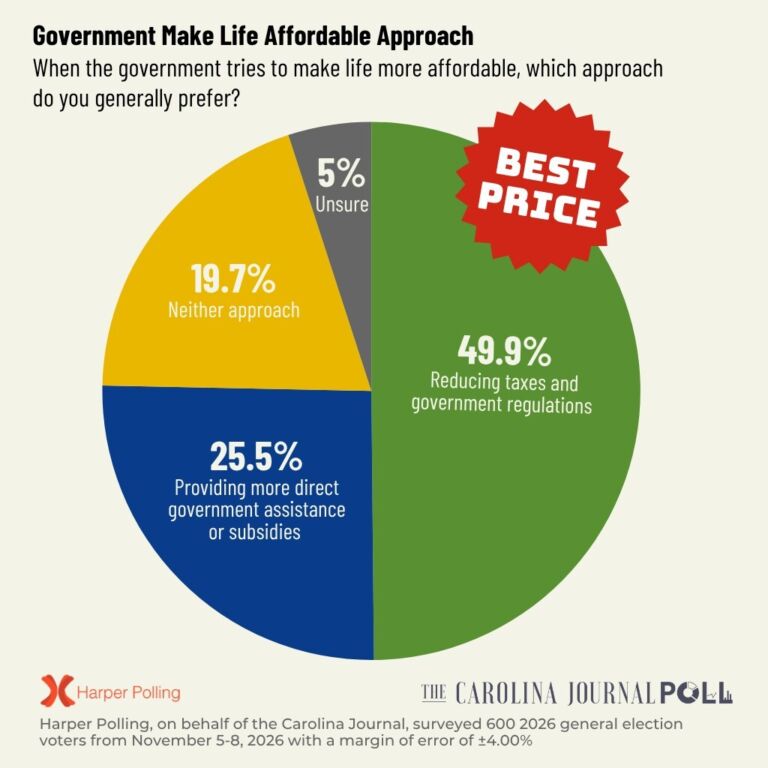
Despite differing views on the causes of inflation, nearly half of voters (49.9%) said they prefer reducing taxes and government regulations as a way to make life more affordable. Just 25.5% preferred providing more direct government assistance or subsidies, while 19.7% preferred neither approach and 5% were unsure.
“The cost of living remains a major concern for North Carolinians, and voters are expressing skepticism about policies they believe contribute to higher prices,” said King. “A majority believe tariffs have increased living expenses, and nearly seven in 10 believe tariffs hurt Republicans in the midterm elections. These findings demonstrate how closely voters are connecting economic policy with their political decisions.”
The poll also examined voters’ attitudes toward government accountability and the balance of power between Congress and the president. A majority of voters (58.4%) believe Congress should play a stronger role in limiting presidential power, regardless of which party controls the White House. More than a third of voters (36.3%) believe Congress should play a much stronger role, while 22.1% favor a somewhat stronger role. Another 26% believe the current balance of power is about right, while 11.2% favor a weaker congressional role and 4.5% remain unsure.
Support for congressional oversight was even higher when voters were asked whether Congress should enforce constitutional limits on presidential authority in areas such as tariffs, emergency declarations, and federal spending, even when the president imposing those policies is someone they support. More than two-thirds of voters (70.2%) support congressional enforcement of constitutional limits, including 47.1% who strongly support it and 23.2% who somewhat support it. Another 23.8% oppose such enforcement, while 6% remain unsure.
“North Carolinians are expressing a strong preference for checks and balances, regardless of which political party holds power,” said King. “More than seven in 10 voters support Congress enforcing constitutional limits on presidential authority, even when they agree with the president’s policies. These results suggest that voters want their elected officials to respect the constitutional separation of powers, regardless of who occupies the White House.”
When asked which poses the greater threat to individual freedom, a narrow majority of voters (51.4%) said there is an equally serious threat from both government and large corporations or other private institutions becoming too powerful. Another 23.4% believe powerful corporations and private institutions pose the greater threat, while 21.2% identified government becoming too powerful as the top threat.
Despite concerns about government power, a majority of voters (54.2%) said they are more concerned about government doing too little to address the problems people face than about government doing too much and interfering in people’s lives. Another 40.8% expressed greater concern about government doing too much, while 4.9% were unsure.
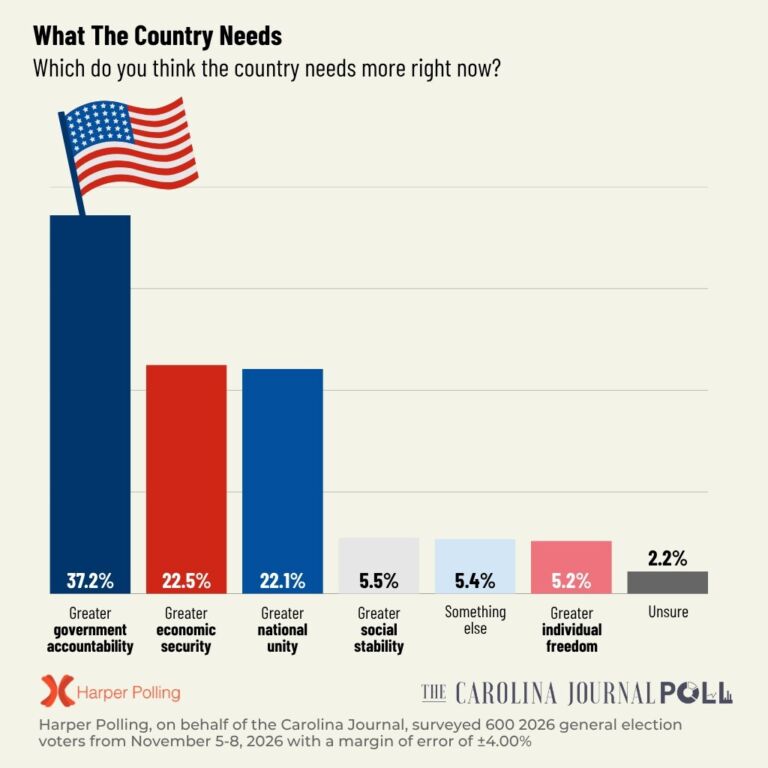
When asked what the country needs most right now, a plurality of voters (37.2%) selected greater government accountability. Greater economic security ranked second at 22.5%, followed closely by greater national unity (22.1%). Smaller shares selected greater social stability (5.5%), greater individual freedom (5.2%), or something else (5.4%), while 2.2% were unsure.
The poll also asked voters to identify the top priority for the newly elected Congress. A plurality of voters (24.2%) selected reducing the cost of living, followed by conducting oversight of the Trump administration (14.6%) and reducing federal spending and debt (13.3%). Other priorities included protecting Social Security and Medicare (10.7%), improving access to affordable health care (9.5%), addressing immigration and border security (8%), and limiting presidential power (6.8%). Smaller shares identified foreign policy and national security (4.3%), changing tax policy (3%), or another priority (4.3%), while 1.3% were unsure.
At the state level, voters were asked what the outgoing North Carolina General Assembly should prioritize before the end of the year. A plurality (20.4%) selected passing a state budget or addressing unfinished budget matters, followed by handling only essential business and leaving major policy decisions to the incoming legislature (15.9%). Providing tax relief ranked third at 15.5%, followed by addressing health care funding and access (14.3%) and education funding (10.5%). Other priorities included considering changes to election laws or government powers (6.3%), hurricane recovery and disaster preparedness (2.5%), and public safety (2.3%). Another 6.2% selected something else, while 6.2% were unsure.
When asked whether the election results gave Democrats a mandate to advance their policy agenda, a plurality of voters (47.3%) said Democrats received a strong mandate. Another 22.8% believe Democrats received a limited mandate, while 17.8% said the party received no mandate. The remaining 12.1% were unsure.
The November poll also examined what voters would like to see from conservative candidates in future elections. Nearly a third of voters (31.9%) said nothing would make them more likely to vote for conservative candidates, while 14.7% selected lowering the cost of living. Another 11.2% identified reducing government spending and debt, followed by a less confrontational style of politics (9.6%), continuing President Donald Trump’s priorities (9.1%), and immigration and border security (8.3%). Other priorities included individual liberty and limited government (5.8%), traditional social values (3.1%), and increasing the money supply through the Federal Reserve (0.2%). Another 6.1% were unsure.
When asked how closely conservatives should continue Trump’s Make America Great Again (MAGA) priorities for the Republican Party to be successful, a majority of voters (54.3%) said not at all. Another 20.8% said conservatives should continue those priorities a lot, while 13.7% said some and 6.7% said a little. The remaining 4.6% were unsure.
Trump’s approval rating also declined considerably following the midterm elections. Just over a third of voters (34.8%) approve of the president’s job performance, down 9.1 points from October, when 43.9% approved. Nearly two-thirds of voters (64.3%) disapprove of Trump’s performance, up from 54.5% last month. A majority of voters (58.8%) strongly disapprove of Trump, compared to 21.4% who strongly approve. Another 13.4% somewhat approve, 5.5% somewhat disapprove, and 1% remain unsure.
The poll also examined confidence in the integrity of the 2026 election. Nearly three-quarters of voters (72.8%) expressed confidence that the election was free and fair, compared to 58.4% who expressed confidence in the October Carolina Journal Poll, an increase of 14.4 points. The share of voters who were very confident increased from 17.1% in October to 53.2% in November, while the share who were not confident declined from 36.9% to 23.1%. The October survey measured expectations before the election, while the November survey measured perceptions after the election.
The increase in confidence was driven primarily by Democrats and independent voters, while Republican confidence declined. Among Democrats, confidence increased from 60% in October to 96% in November, a 36-point increase. Confidence among independents increased 18 points, from 64% to 82%. Conversely, Republican confidence declined 15 points, from 56% to 41%, while the share of Republicans who were not confident increased from 39% to 51%. The partisan gap in election confidence widened considerably, from just four points between Democrats and Republicans in October to 55 points in November.