Our reading recession
Published July 30, 2026
By Tom Campbell
Can you remember the name of the last whole book you read? How long ago was it? If you can’t remember you aren’t alone.
An American Time Use Survey of 236,000 by The National Endowment for the Arts revealed that only 38% read a novel or short study in 2024. And the proportion of Americans who read for pleasure on any given day fell from 28% in 2004 to 16% in 2023.
My love of reading began in childhood. I remember my mother reading to me. She was a prodigious reader and taught her children to love reading by example. Back in the 50s, folks were worried about polio afflicting children and, as a precaution, mother made us rest each afternoon for an hour or so. We didn’t have to sleep, but we had to be quiet. We read books. I now believe it was as much to give mother a break as it was about the polio scare.
In summer months, when school was out, mother would take us to Shepherd Memorial Library in Greenville every two weeks, with instructions that we could check out five books on any subject we liked. If our library had books with profane, explicit or violent content, head Librarian Lib Copeland kept them hidden from children. My choices were biographies of sports heroes, adventure stories or novels like The Hardy Boys.
North Carolina is currently in a “reading recession,” according to The Education Scorecard. We rank 22nd of 35 states in reading, with scores a half grade lower than in 2019. It’s not just being able to read words that is problematic but reading comprehension has suffered badly. Just 35 percent of high school seniors are “proficient” in analyzing themes and evaluating conclusions from texts they read. Scores on the ACT college entrance exam have been falling for the past seven years and are at the lowest levels in three decades.
Busy parents don’t read to their children as much as ours did. Middle and high school teachers report assigning zero to four books a year to their students, a 2025 survey found. Instead, teachers now favor assigning short passages or excerpts to be read instead of the entire book. Maybe you can remember having to make book reports in writing or orally to your class on books you were assigned to read like A Tale of Two Cities, 1984, Animal Farm, Wuthering Heights, Anne of Green Gables.
And, while the data regarding current students should concern us there is ample evidence that the reading recession cuts across all age groups, especially among the groups that have traditionally read the most, like women, retirees and college graduates. Data indicates that fewer than 30 percent can paraphrase or draw inferences from multiple page writings.
Rose Horowitch, in a recent Atlantic article titled, The End of Reading is here, reports that the books that we do read are simpler than they once were, with less literate vocabulary. We get far less news from reading. In 1975, about half of twenty-somethings said they read a newspaper every day. Today, it’s less than 10%. Most get news from smartphones and laptops and 40% say they would rather hear and watch news online instead of having to read it.
Interestingly, Horowitch reports, we are reading more words than ever before. The difference is what we read and how we read them. Texts, emails, sentence fragments on X, Reddit and Instagram have taken the place of longer, perhaps more complicated information.
A lot of these threads look more like code. Between the acronyms and initialisms, the SMS shorthand is boggling.
IDK what most of them mean, but ISTG they leave me so frustrated that I just want to say NVM and respond with TTYL.
Maryanne Wolf, a neuroscientist from UCLA says “America, in other words, isn’t illiterate. It’s postliterate.” According to Google AI (another subject worth debate), “Post-literacy means a cultural stage where printed text is no longer the main way people share or value information. Instead, images, video, and audio take its place. People still know how to read, but reading books is no longer the center of daily life.”
When you understand that the amount of knowledge doubles every 13 months you have to wonder who (or what) is going to read and analyze what is being learned? And how will it be imparted to you and me?
We love our smartphones, tablets and laptops. Data reveals we spend 6 hours and 54 minutes a day looking at screens, much of it on texts, news briefs, games or entertainment pieces. But it’s not the same as reading a book.
Not only is reading fundamental but it helps gives us pleasure, adds perspective, teaches us history, improves our critical thinking skills, as well as our language and relational skills.
Thank you for reading this column.
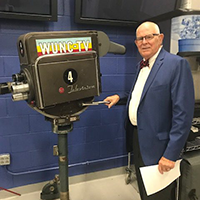
Tom Campbell is a Hall of Fame North Carolina broadcaster and columnist who has covered North Carolina public policy issues since 1965. Contact him at tomcamp@ncspin.com