September 2026 — Roy Cooper’s lead grows to 15 points in NC Senate race
Published 11:06 p.m. yesterday
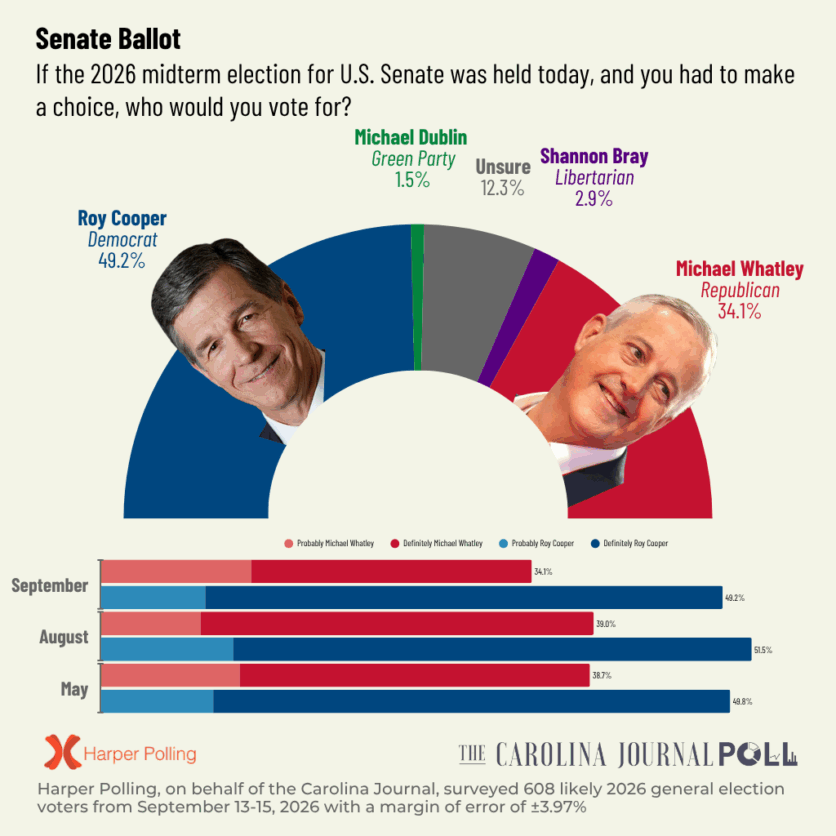
With just a month and a half left until Election Day, Democratic former Gov. Roy Cooper has grown his lead in the US Senate race to 15.1 points over former Republican National Committee Chairman Michael Whatley. A plurality of 49.2% of likely North Carolina voters intend to vote for Cooper, according to the latest Carolina Journal Poll, while only 34.1% intend to vote for Whatley. Libertarian Shannon Bray received 2.9% support, Green Party candidate Michael Dublin garnered 1.5% support, and 12.3% are still undecided.
While Whatley has increased his name recognition from earlier polls, 31.6% of voters still have either no opinion of Whatley or have never heard of him. Among those who are familiar with Whatley, a plurality (42%) of voters shared an unfavorable opinion of him, while just 26.4% viewed him favorably. Comparatively, Cooper’s favorability is positive by four points, with 47.1% of voters sharing a favorable view of him and 43.1% sharing an unfavorable view.
“The latest poll shows that Whatley has increased his name recognition, but that hasn’t yet closed the gap with Cooper,” said Donna King, Executive Vice President of the John Locke Foundation and publisher of Carolina Journal. “The question over the final six weeks is how voter perceptions change as more North Carolinians become familiar with Whatley and the Senate race receives greater attention.”
These favorability ratings track closely with Republican President Donald Trump and Democratic Gov. Josh Stein. Similarly to Whatley, Trump’s approval rating is underwater, albeit more dramatically, with 57.1% of voters disapproving of the job the president is doing, and 41.1% approving. Gov. Josh Stein has a similar approval rating to Cooper, at 49.4%, but his disapproval rating is lower at 32.9%, putting him 16.5 points in the positive.
In the state Supreme Court race, Democrat Anita Earls enjoys nearly an 11-point lead over Republican Sarah Stevens. A plurality of voters, 47.2%, intend to vote for Earls, while 36.4% said they intend to vote for Stevens.
Voters overall trended in favor of Democratic candidates in this poll, with 51.1% of voters sharing that they intend to vote for a Democratic candidate for Congress, compared to 41.9% who intend to vote for a Republican. Similarly, 49.5% of voters said they intend to vote for a Democratic candidate for the North Carolina General Assembly, while 41.3% said they intend to vote for a Republican.
It is not uncommon for the party that holds the presidency to see losses during midterm elections, and this year’s midterm wave may be intensified by voters’ negative perceptions of the country’s trajectory. A majority of voters (61.5%) say that America is currently on the “wrong track,” while only 33.4% believe it is headed in the “right direction.” This dissatisfaction rate is the highest it has been since September 2024— the last Carolina Journal Poll before that year’s general election.
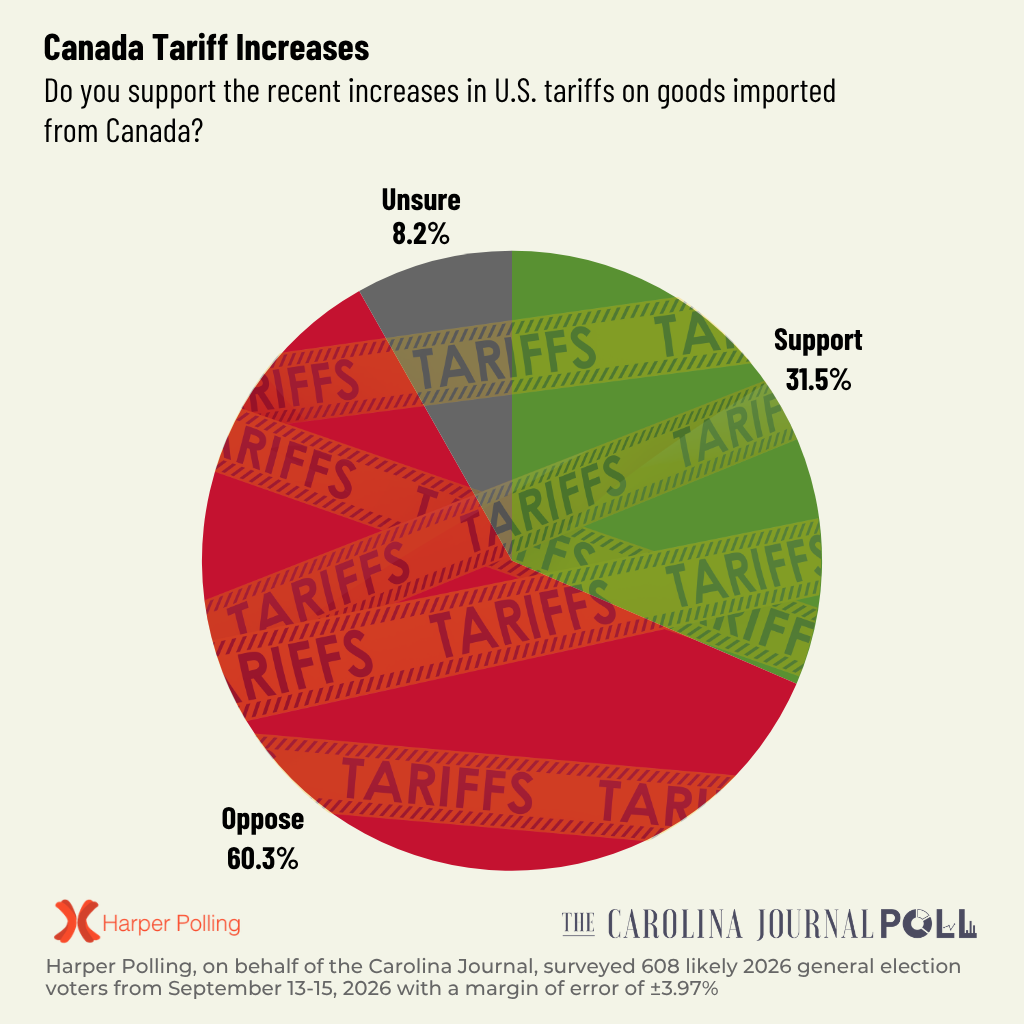
Among the potential concerns that are driving this dissatisfaction are the Iran war and tariffs. When asked about the war with Iran, 58.9% said going to war was the wrong decision, while only 33.8% believe it was the right decision. A slightly larger percentage of voters (38.8%) support continued action in Iran; however, a majority (53.5%) oppose continuing the conflict. On the matter of tariffs, 60.3% of voters oppose the recently placed tariffs on Canada, and only 31.5% support these tariffs. Nearly three-quarters (74.4%) of voters acknowledge that these tariffs will increase prices for consumers in North Carolina, while 12.8% disagree, and 12.8% were unsure.
Trump’s poor approval rating appears to have an effect on the midterm pivot away from the majority party as well, with 50% of voters stating that a Trump endorsement makes them less likely to vote for a candidate. Only 26.1% said that a Trump endorsement would make them more likely to vote for someone. Among self-proclaimed moderates, 72% said a Trump endorsement would make them less likely to vote for a candidate.
Trump has endorsed Whatley for Senate, and 73.9% of voters believe that Whatley will support the priorities of the Trump administration if elected. Less than ten percent (9.2%) of voters do not believe he will support Trump’s agenda. By comparison, 60.1% of voters believe that, if elected, Roy Cooper would support the policy priorities of the Democratic Socialists of America, with 20.7% in disagreement.
Outside of political candidates, North Carolinians will have three constitutional amendments on their ballot this year. The first referendum on the ballot would enshrine absentee voter ID into the state constitution. Nearly two-thirds (66.4%) support adding absentee voter ID to the state constitution, and 28.8% oppose. This amendment has nearly unanimous support among Republicans (95%), 63% support among independents, and 42% support among Democrats.
The second referendum on the ballot would cap North Carolina’s income tax rate at 3.5%. This amendment has even greater support than absentee voter ID, with 66.9% of voters in favor. This amendment enjoys majority support regardless of party affiliation, with 80% of Republicans, 65% of independents, and 56% of Democrats in favor. Only 23.6% of voters oppose the income tax cap amendment.
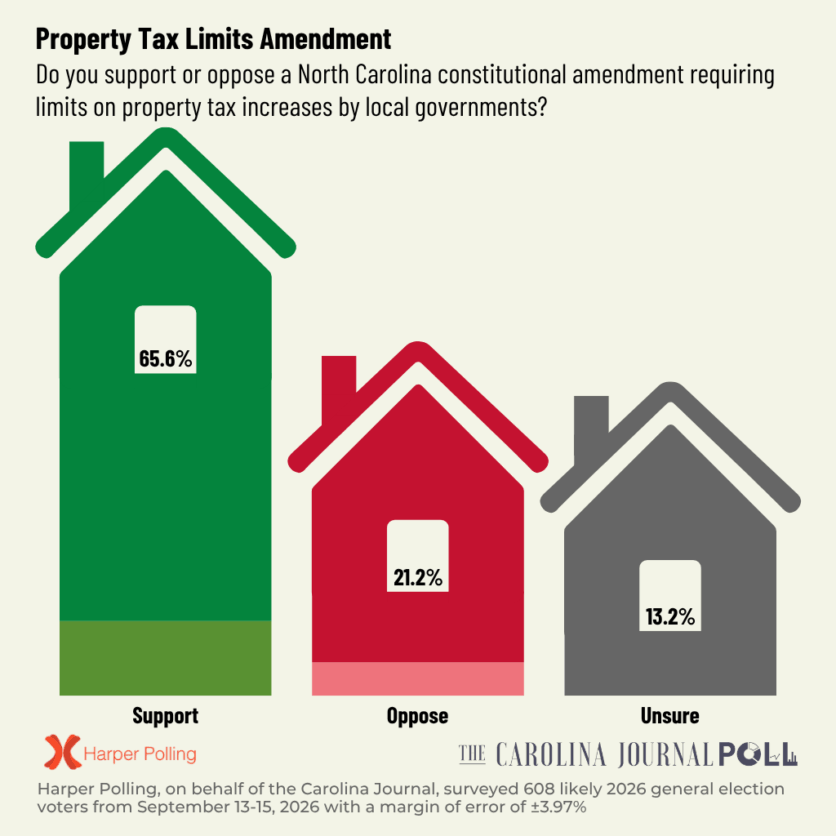
The final referendum on the ballot would limit how much local governments can increase property taxes. Similar to the others, 65.6% of voters support the tax cap, and this amendment has the lowest level of opposition, at only 21.2%. When asked about their satisfaction with how their property taxes were being used, a majority of voters (56.2%) said they were unsatisfied with how local governments spend tax dollars, compared to 30.7% who said that they were satisfied.
“What stands out in these numbers is the breadth of support across all three amendments,” King continued. “Even in a deeply divided political environment, North Carolina voters are finding common ground on questions about taxes, property rights, and election security.”
On the matter of elections themselves, 50.2% of voters said that new election performance audits would make them more confident in the accuracy of North Carolina election results. Many voters (31.9%) were unsure if election performance audits would affect their confidence in election results, while 17.9% of voters said audits would make them less confident.
Earlier this year, legislators introduced a bill that would require public schools to post their lesson plans online. A majority of likely North Carolina voters (59%) support this measure, while 28.7% oppose the idea.
On immigration, the Carolina Journal Poll surveyed support for Immigration and Customs Enforcement (ICE). Voters were significantly more divided on this issue, with 50.4% believing that ICE should be preserved, and 40.1% in favor of abolishing ICE. This represents a major decline in public support for ICE among North Carolinians, as 67% of North Carolinians supported ICE in a 2018 Civitas Poll.
Voters are even less supportive of data centers in North Carolina. A strong majority (70.4%) of voters said that they would oppose building a new data center in their community, with only 16.5% in support. When asked if America needs more data centers, 17.8% supported adding data centers, 32.5% said the country has enough of them, and 30.7% said America has too many.