The transformation of GOP masculinity, from Reagan to Mark Robinson
Published 5:14 p.m. today
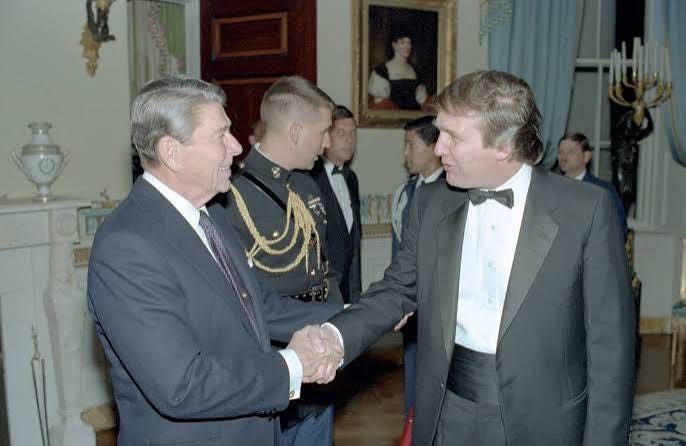
Photo credit: The Wall Street Journal
Republican presidents have long projected an aura of masculine authority. The power of the office imbued any occupant with an air of grandeur, but the Republican Party placed particular emphasis on a strong, authoritative bearing, and the image was gendered male. In 2026, the GOP is more than ever the party of men. But the patriarchs they elevate have passed from an older masculinity to a male ideal that is particularly appropriate to our age of misogyny, the manosphere, and Trump.
The gender gap did not always identify Republicans as the male party. Until the 1980s, women tended to vote for Republican candidates. But, not coincidentally, the 1970s rise of second-wave feminism and growing numbers of women in the workforce activated a latent sexism in conservative politics. Conservative evangelicals rose from a political slumber that had begun with the Scopes monkey trial to fight back against feminism’s challenge to traditional American patriarchy. Republicans starting with North Carolina’s Jesse Helms and, most significantly. President Ronald Reagan, embraced the rising religious right as a potent asset in electoral politics. Henceforth, Republicans would be the party of men.
As the party committed to defending old-school patriarchy, Republicans preferred to nominate strong masculine figures for president. Reagan was a tall movie star who looked virile riding horses on his California ranch. George H. W. Bush’s masculinity wasn’t as immediately identifiable as his former boss’s—to the point that Newsweek questioned his manhood with a headline titled “The Wimp Factor”—but Poppi Bush had grown up being considered as something of an athletic stud. His son brought a cowboy’s swagger to the White House.
But these men’s masculinity was tempered by an old-school ethos of restraint and male self-mastery. Reagan may have made crude jokes in private, but he always carried himself with presidential dignity. George W. Bush made a forceful case against Islamophobia after 9/11. This was the masculinity of Humphrey Bogart and other golden-age stars, not the whirling-dervish masculine destructiveness of “Scarface.”
In other words, Republicans were the party of “Mr. Gorbachev, tear down this wall.” They were the party of "freedom itself was attacked last night by a faceless coward. And freedom will be defended.”
In a culture where patriarchy has deep roots, the Republicans’ performative masculinity drew a growing number of men to their side. The 2000 election saw the largest gender gap that had ever been seen, with men voting heavily for George W. Bush and women equally emphatic in their preference for Al Gore. Democrats had benefited from their support for female voters, but Republicans even believed (in a way that was clearly sexist) that their party’s machismo would attract married women and gender traditionalists. The meme, as it was then called, of “Hot Mitt" represented this narrative’s descent into self-parody.
If there was a limit to the Republicans’ growth among men, it seemed to lay very far in the future. While Barack Obama had overperformed among male voters, Donald Trump embodied and supercharged the Republican Party’s brand as a party for men and masculinity. He spewed vicious, unfiltered misogyny. He derided women’s physical appearance. He bragged about committing sexual assault. This vile stew of demagoguery and woman-hatred appealed to millions of American men somewhere deep in the prehistoric parts of their brains, and Trump began attracting support from men across the social and racial spectrum.
Trump’s rise as the male vindicator coincided with an ugly spasm of toxic masculinity in our society. Women have made striking gains over the last sixty years. By the 2010s, women had clearly surpassed men in educational achievement and held a majority of professional and managerial jobs. A growing number of women outearned their husbands. Some men accepted this, more or less. Many, many other men—particularly men from the working class who had lost the most ground socially—responded with an old vindictiveness that fueled misogynistic podcasts, a festering “manosphere,” and a striking rise in toxic masculinity.
Fans of this new-model maleness were unlikely to be drawn to stern, dignified men like Reagan and the Bushes. It was Donald Trump and his brutish assertion of male power that drew millions of young, working-class, nonwhite and other nontraditional male Republican voters to the banner of the GOP. These men were frustrated in life and resentful of women. Many of them relished the dark magic of toxic masculinity. Trump was this masculinity’s merchant, and he made the Republican Party into a vehicle for its political expression.
A wave of toxic men emerged across the country. We have seen some of the tawdriest examples of this new cohort in our own state. Bo Hines ran ads showing him literally flexing his muscles. Mark Robinson was the apogee of masculine garbage, saying that women were “called to be led by men” and screaming bloody murder about how “if you kill that child” by having an abortion “it’s murder!”
Republicans were no longer the party of “Mr. Gorbachev, tear down this wall.” They were the party of “some folks need killin’.”
The Trump-led GOP was hardly the first political party to exploit the ugly, bigoted edges of American culture. In the early 20th century, Mississippi Governor James Vardaman said white people should lynch every Black person in his state rather than allow African Americans to vote. The California Workingmen’s Party of the 1870s ran on the slogan “the Chinese must go.” We are a country, alas, that has harbored and weaponized many forms of human hatred. And these viruses have inhabited our political bloodstream.
But I have hope. I have hope that this toxic masculinity, while powerful and likely to endure with the fuel of male resentment, will represent the limits of bigotry as a political tool. Trump’s misogyny won him the 2024 election but also triggered an ongoing backlash led by women disgusted at his brutish sexism. College-educated men became increasingly resistant to Trump and his cultural vibe in 2024. These men are not morally superior to working-class men (see Elon Musk). But, as elitist as it may sound, scholars like psychologist Steve Pinker have found that moral progress often originates with the educated class. I think a backlash to male-vengeance politics has begun to brew, and that in the next decade the forces of misogyny will finally lose a round.
Subscribe to Alexander's New Branchead blog here