Carolina Journal Poll: Roy Cooper leads Michael Whatley in Senate Race by nearly 8 points
Published March 26, 2026
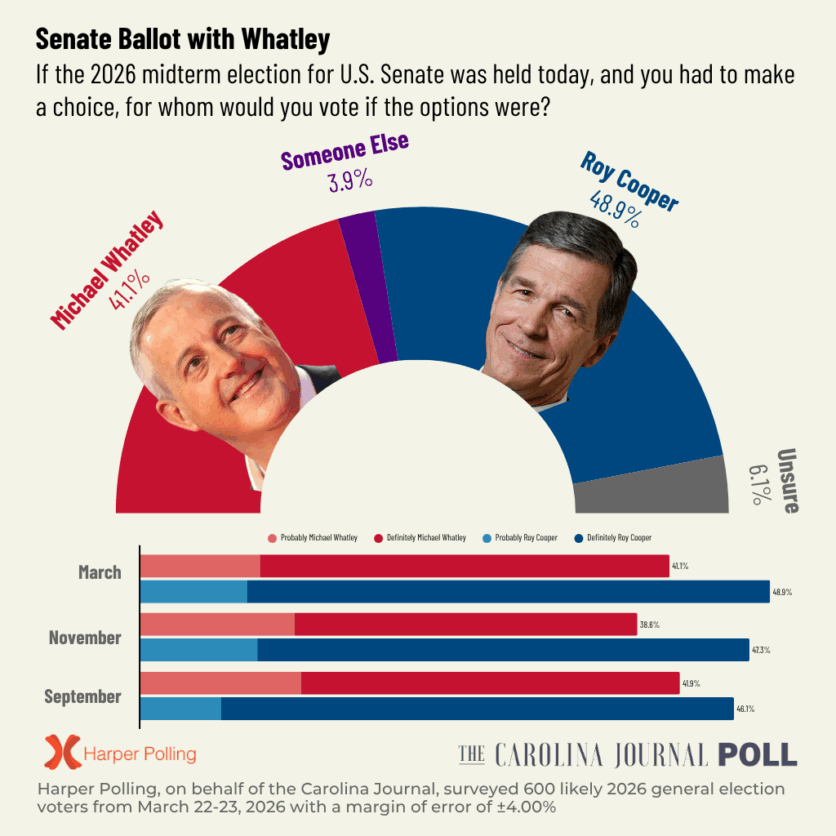
With primary season officially over in North Carolina, all eyes are set on North Carolina’s US Senate race. According to the latest Carolina Journal Poll, a survey of 600 likely North Carolina voters, Democratic former Governor Roy Cooper (48.9%) leads Former Republican National Committee Chairman Michael Whatley (41.1%) by 7.8 points. Among registered independents, Whatley falls further behind with 32% support versus Cooper’s 52% support.
The Democratic Party has a lead over the Republican Party in all other races polled. When asked whether they plan to vote for a Democratic candidate or a Republican candidate in US congressional races, Democrats (48.3%) came out 4.5 points ahead of Republicans (43.8%). Democrats also had a lead, albeit smaller, in the generic General Assembly race, with 45.3% of voters stating that, if the race were held today, they would choose a Democratic candidate and 43.2% saying that they would vote for a Republican candidate. It is worth noting that this 2.1-point lead is well within the poll’s ±4.00% margin of error.
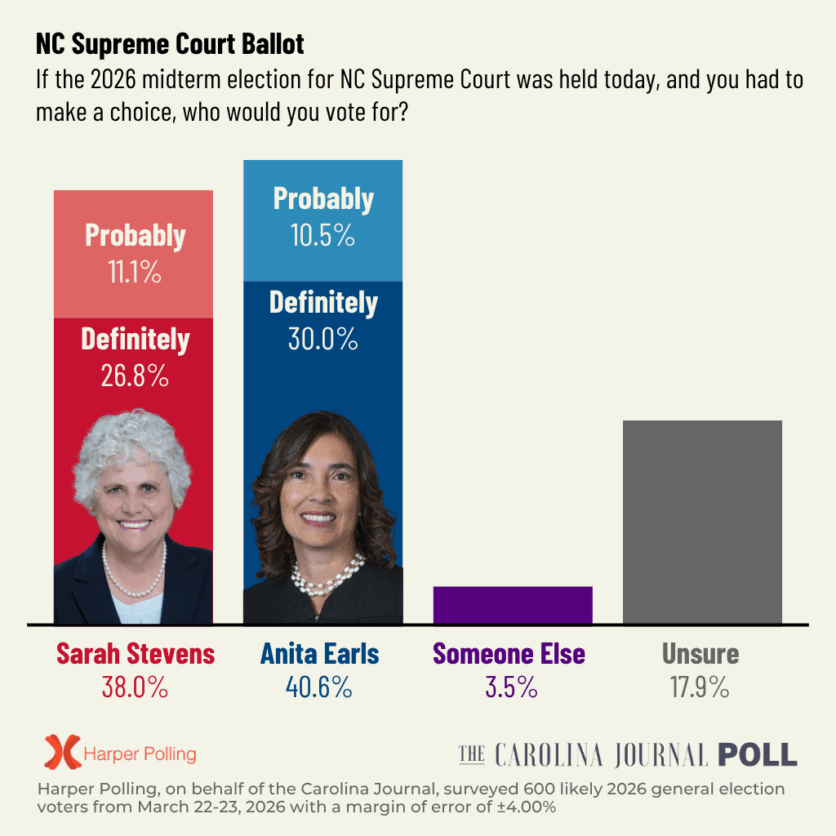
When given specific candidates for the North Carolina Supreme Court race, Democrats saw a similarly tight lead, with incumbent Justice Anita Earls garnering 40.6% support compared to Republican challenger Sarah Stevens’ 38%.
“Midterm elections are almost always a referendum on the party in the White House, and this poll shows that dynamic is alive and well in North Carolina,” said Donald Bryson, John Locke Foundation CEO and Carolina Journal publisher. “With more voters saying the country is on the wrong track and the president underwater, the environment is naturally tilting toward the out-party.”
Democratic North Carolina Governor Josh Stein enjoys popular support, with his job approval rating clocking in at 50.5%, 17.7 points above his disapproval rating. Republican President Donald Trump, on the other hand, continues to be underwater in his job approval. A majority (53.7%) of voters said they disapprove of the job Trump is doing as president, compared to 44.8% who approve. This is the highest disapproval rating that the Carolina Journal Poll has recorded since Trump began his second term.
A similar share of voters believe that the United States is on the “wrong track” (55.7%), with only 38.8% believing America is headed in the “right direction.” Pessimism is lower about the direction of the state, with 46.4% believing that North Carolina is on the wrong track and 33.1% believing that it is headed in the right direction; however, significantly more voters (20.5%) are unsure about the direction of North Carolina.
This month’s Carolina Journal Poll surveyed voters on several policy issues. While there are several matters where general election voters overwhelmingly agree, the issue upon which voters agreed the most concerned North Carolina’s ongoing budget impasse. A supermajority (84.4%) of voters support a requirement for state legislators to forgo their pay from the time a state budget expires until the next biennial budget is passed. Only 7.5% of voters opposed this proposal.
When asked about other General Assembly reforms, three-quarters of voters shared support for legislative term limits, 69% supported legislative leader term limits, 28.2% support limits on session length, and only 6% support increasing legislators’ salaries.
Another matter where voters demonstrated overwhelming agreement concerned data centers for artificial intelligence. Nearly four-fifths of voters (78.2%) agreed that new data center facilities should have to provide for their own energy generation, and 59.8% of voters “strongly” supported this measure. Less than 10% of voters opposed requiring data centers to provide for their own electricity.
On other matters of electricity, a majority of voters (51.9%) stated that they support replacing retiring coal-fired power plants with equally reliable energy sources, meaning sources of energy that are capable of providing power any time of day or night without backup. Slightly more than a quarter of voters (27.6%) opposed this replacement plan, with 20.6% of voters unsure.
When asked about North Carolina’s 2050 carbon mandate, 32.6% of voters shared support for keeping the legal net-zero mandate even if it meant higher energy bills. A combined 51.2% of voters said they would not keep the 2050 carbon mandate, with 25.2% saying they support the goal, but it should not be a legal requirement, and 26% saying they would end the net-zero goal altogether.
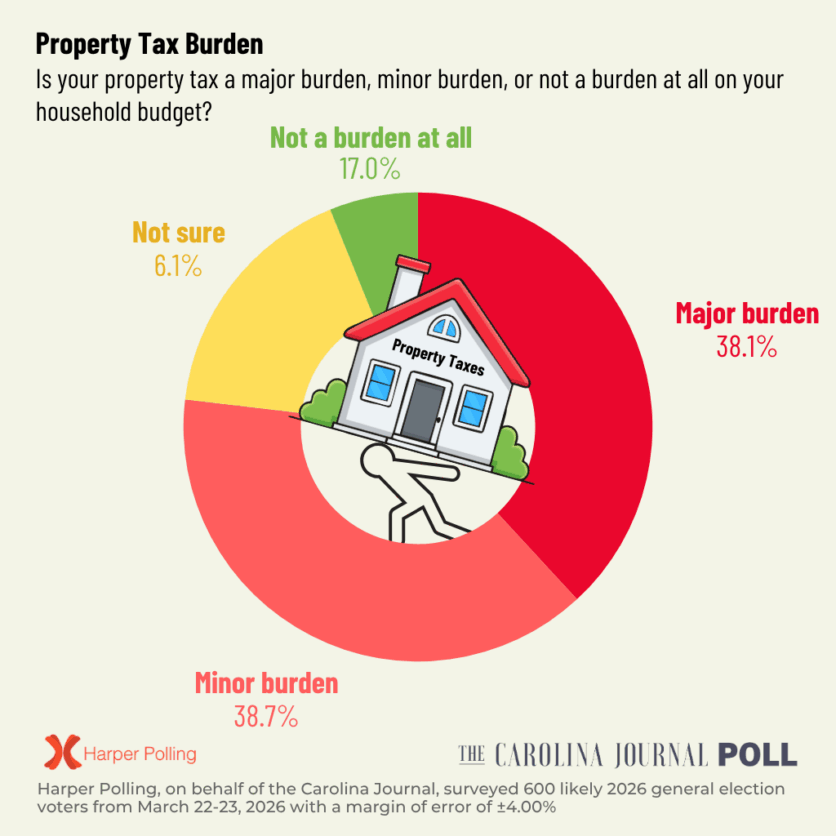
When asked about their household budgets, 76.8% of North Carolinians stated property tax was a financial burden. A slim plurality (38.7%) said property tax was a minor burden, 38.1% said it was a major burden, and only 17% said it was not a burden at all. When asked if they would support limiting property tax increases, 73.2% said they would support such a limitation, and only 11.9% said they would oppose.
“In a year when property taxes are front and center across the country, North Carolina voters are sending a clear message: rising property taxes are a burden, and they want limits,” continued Bryson. “That’s a powerful signal for policymakers heading into the legislative session.”
On the topic of housing, the poll uncovered that most North Carolinians (55.8%) do not believe building more homes would lower the price of housing. Only around one-third of voters (33.6%) believe that building more homes would lower the price of housing.
North Carolinians, however, do believe in supporting innovative technologies, with 50.8% of voters supporting regulatory sandboxes that would offer companies exploring innovative technologies temporary exemptions from certain government regulations. Only 21.7% of voters opposed the idea, and 27.4% of voters were unsure.
Continuing with policies that primarily affect businesses, a plurality of voters (47.1%) said that they would support a repeal of North Carolina’s franchise tax, which is a tax on a business’s net worth or capital, regardless of whether the company turned a profit in that given year. Opposition to a repeal of the franchise tax was nearly 10 points lower at 37.2%.
When it comes to the licensing of certain occupations, North Carolinians were skeptical of reform. A plurality of voters (47.2%) said they would oppose reduced licensure requirements for the state’s 160 licensed occupations, whereas 38.9% said they would support reductions in licensing requirements.
Voters were more closely split on the matter of Certificate of Need reform. A slim plurality of voters (41.8%) said they would support repealing the state law that requires healthcare providers to get permission from the government before they can add beds, major equipment, or expand services, while 38.2% would oppose a repeal — a 3.6-point difference.
One medical matter that voters overwhelmingly agree on, however, is involuntary commitment. Nearly 70% of voters said that they would support an increase in the use of involuntary commitments as a means to ensure that people with severe mental illnesses get the treatment they need. Only 16.3% of voters would oppose an increased use of involuntary commitment.