HPU Poll: Survey Reveals Gaps in Awareness and Use of 988 Suicide and Crisis Lifeline
Published May 27, 2026
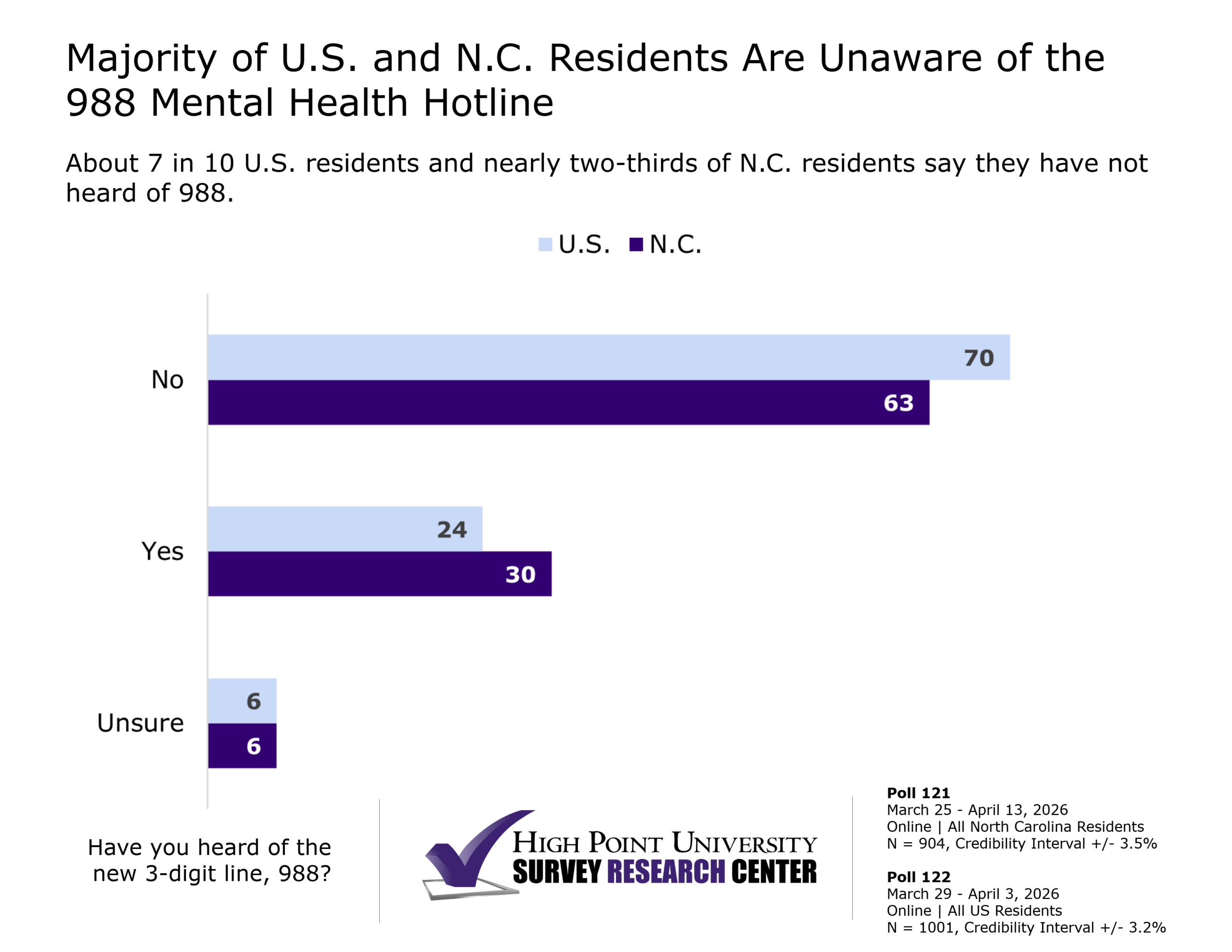
High Point University’s recent survey of both United States and North Carolina residents reveals gaps in public awareness and understanding of the 988 Suicide & Crisis Lifeline, underscoring the urgent need for expanded education and outreach efforts as Mental Health Awareness Month highlights the importance of accessible and timely mental health support.
While 988 may serve as a vital national resource for individuals experiencing mental health crises, awareness remains limited. Only about one-quarter (24%) of U.S. residents and 30% of North Carolina respondents reported having heard of 988. Meanwhile, large majorities — 70% of U.S. residents and 63% of North Carolina residents — said they had not heard of it. These findings suggest that despite national rollout efforts, many individuals may not know how to access immediate mental health support when needed.
Utilization of the service also remains low. Only 7% of U.S. respondents and 12% of North Carolina respondents reported that they or someone they know has used 988, compared to 80% of U.S. respondents and 72% of North Carolina respondents who have not and do not know anyone who has used the service.
Experts from HPU’s Teresa B. Caine School of Nursing say these findings are especially significant during Mental Health Awareness Month, a time dedicated to reducing stigma and promoting access to care. They noted that the 988 Suicide & Crisis Lifeline offers free, confidential, 24/7 support for individuals experiencing emotional distress, suicidal thoughts or mental health crises, yet this survey indicates that many individuals may not fully understand or utilize this critical resource.
“Access to mental health support depends not only on the existence of services, but on individuals knowing when and how to seek help,” said Dr. Lorrie R. Davis-Dick, HPU assistant professor and psychiatric mental health/community health coordinator. “The widespread confusion surrounding 988 identified in this study suggests missed opportunities for early intervention and prevention — particularly among vulnerable populations —reinforcing the importance of advocacy, education and trusted community partnerships.”
Improving awareness of 988 is essential to strengthening community mental health outcomes, Caine School of Nursing experts said. Efforts such as integrating mental health education into schools, increasing provider communication and leveraging media campaigns may help ensure individuals know when and how to seek help.
North Carolina Residents – Mental Health & 988 Awareness (March – April 2026)
| You likely have heard of some 3-digit telephone lines, such as 911 and 311. Have you heard of the new 3-digit line, 988? | |
| N.C. Resident Adults | |
| Yes | 30 |
| No | 63 |
| Unsure | 6 |
| Have you or someone you know used 988? | |
| N.C. Resident Adults | |
| Yes | 12 |
| No | 72 |
| Unsure | 16 |
United States Residents – Mental Health & 988 Awareness (March – April 2026)
| You likely have heard of some 3-digit telephone lines, such as 911 and 311. Have you heard of the new 3-digit line, 988? | |
| U.S. Resident Adults | |
| Yes | 24 |
| No | 70 |
| Unsure | 6 |
| Have you or someone you know used 988? | |
| U.S. Resident Adults | |
| Yes | 7 |
| No | 80 |
| Unsure | 13 |
Methodology:
HPU Poll 121 was fielded by the High Point University® Survey Research Center from March 25 to April 13 as an online survey using a panel of respondents recruited and maintained by Dynata. Dynata sent invitations to its panel of North Carolina respondents and the SRC collected 904 responses (an all-adults sample) on its Qualtrics platform.
HPU Poll 122 was fielded by the High Point University® Survey Research Center from March 29 to April 3 as an online survey using a panel of respondents recruited and maintained by Dynata. Dynata sent invitations to its nationwide panel of respondents and the SRC collected 1,001 responses (an all-adults sample) on its Qualtrics platform.
The online samples were from panels of respondents, and their participation does not adhere to usual assumptions associated with random selection. Therefore, it is not appropriate to assign margins of sampling error for the results.
For the all-adults HPU Poll 121 sample, the SRC provides a credibility interval of plus or minus 3.5 percentage points to account for a traditional 95% confidence interval for the estimates (plus or minus 3.3 percentage points) and a design effect of 1.1 (based on the weighting).
For the all-adults HPU Poll 122 sample, the SRC provides a credibility interval of plus or minus 3.2 percentage points to account for a traditional 95% confidence interval for the estimates (plus or minus 3.1 percentage points) and a design effect of 1.1 (based on the weighting).
In all cases, the data is weighted toward population estimates for age, gender, race, education and ethnicity based on U.S. Census numbers for the respective adult populations of the United States and North Carolina. The High Point University® Survey Research Center (SRC) produces weights through an iterative procedure within SPSS. Factors such as question wording and other methodological choices in conducting survey research can introduce additional errors into the findings of opinion polls.
Further results and methodological details from the most recent survey and past surveys can be found on the Survey Research Center website. Materials online include past press releases as well as memos summarizing the findings (including approval ratings) for each poll since 2010.
The HPU Poll reports methodological details in accordance with the standards set out by AAPOR’s Transparency Initiative, and the HPU Survey Research Center is a Charter Member of the Initiative.
Dr. Martin Kifer, chair and professor of political science, serves as the executive director of the HPU Poll for the Survey Research Center.
Dr. J.R. Moller serves as the staff director of the HPU Poll for the Survey Research Center.
Natalie Hinson serves as senior research assistant for the HPU Poll at the Survey Research Center.