Immigrants are helping NC and its economy grow. We need a fair and just immigration policy
Published February 19, 2026
North Carolina is one of the nation’s most attractive migration destinations, currently ranking third behind Florida and Texas. Averaging 374 newcomers daily, net migration—more people moving in than leaving — was responsible for 95% (573,272) of the state’s absolute population growth (604,525) between 2020 and 2024.
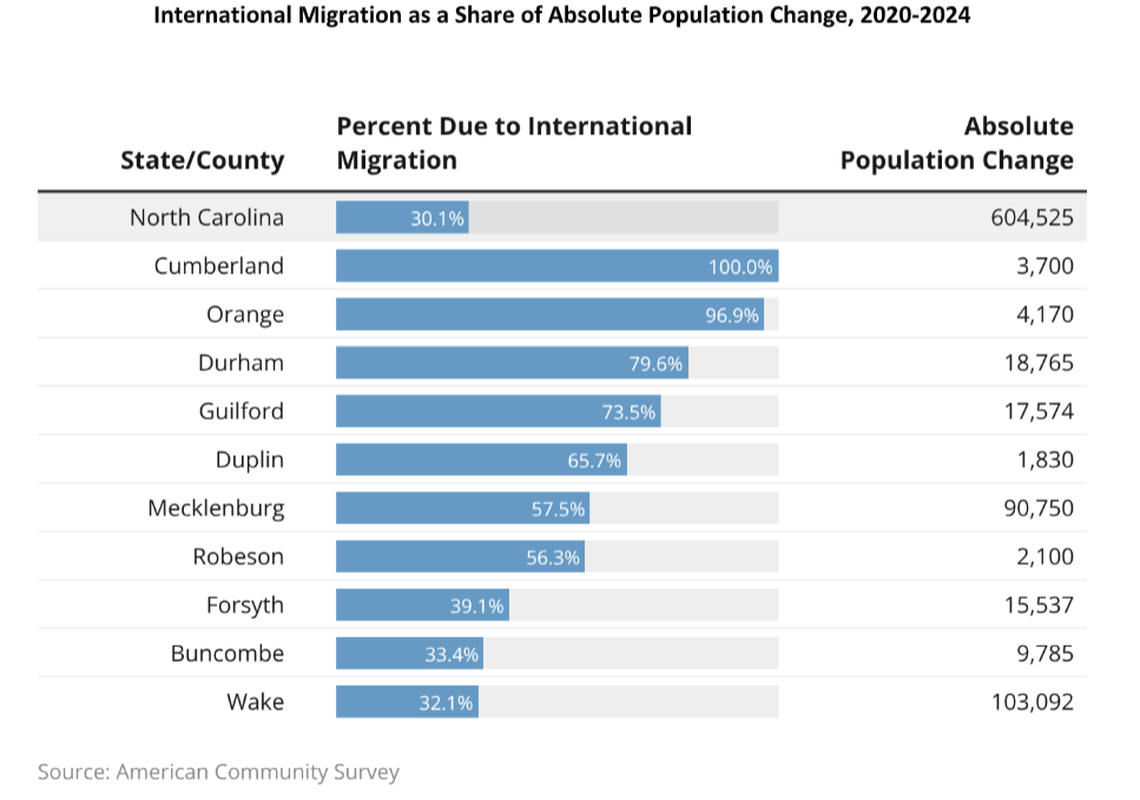
Thirty percent of North Carolina’s newcomers moved from abroad (182,263). And, notably, these international migrants assumed residence and drove population growth in some of the state’s major hubs of higher education, employment, research and development, sports, entertainment, and recreation.
Between 2020 and 2024, transplants from abroad were responsible for more than 75% of net population growth in Cumberland, Durham, and Orange counties; 50-75% of net growth in Mecklenburg, Guilford, Duplin, and Robeson counties; and between 30% and 49% of growth in Wake, Forsyth, and Buncombe counties. In absolute numbers, close to half of the international migrants settled in the state’s two most rapidly growing counties: Mecklenburg (52,154) and Wake (33,145).
Given ongoing restrictions on international migration and accelerating deportation of immigrants, the crucial question is this: Can North Carolina — a state in which international migration has played a critical role in growth and development — maintain its reputation as one of the best places to live and to do business in America in the future?
The answer depends on how we respond to other disruptive demographic trends we are experiencing as a nation and as a state: declining fertility, population aging, age-related mortality, and premature deaths of despair among native born Americans. If international migration is curtailed, census statistics confirm that these forces will continue to contribute to a progressive slowing of the annual rate of U.S. population growth and foreshadow absolute population decline — a historic first for our nation.
Despite high rates of domestic migration (movers from other states totaled 391,010 between 2020 and 2024), to avoid this scenario, a major policy course correction is necessary for North Carolina to maintain its competitiveness in domestic and international markets. More specifically, it will require federal and state policymakers to recognize the pivotal role that immigration — a major driver of population growth over the past six decades — must continue to play in U.S. society. It also will require policymakers to acknowledge and embrace the competitive advantage that our immigrant-driven population — and the diversity of that population — gives us. Research confirms diversity enhances creativity and the innovation capacity of our nation and this state.
A fair and just immigration policy is a strategic imperative for future growth and economic prosperity — in North Carolina and beyond. In reforming existing law and repealing executive orders governing immigration, the goals should be similar to those that led to the passage of the Immigration and Nationality Act of 1965. Also referred to as the Hart-Cellar Act, the law replaced a “half-century old discriminatory national origins system; prioritized family reunification, employment, and refugee status; and opened the doors of the U.S. to non-European immigration.”
And, given the documented adverse impacts of ongoing turbulence and uncertainty on U.S. and North Carolina households, public and private sector organizations must display greater empathy and compassion in recruiting, managing, and retaining the diverse talent that a renewed emphasis on immigration-driven population change will afford us. This will require a laser-like focus on the iceberg or “hidden” workforce and workplace challenges and barriers that undergird the “unfilled jobs” problem in America. For the nation and this state, taking these necessary steps will constitute a recommitment to the American Ideal of fairness, justice, and economic opportunity for all.
James H. Johnson Jr. and Jeanne Milliken Bonds are professors at UNC-Chapel Hill Kenan-Flagler Business School.