NC’s educator pipeline: Urgent need for state action
Published December 11, 2025
By Dr. Deanna Townsend-Smith
Dudley Flood Center for Educational Equity & Opportunity
In December 2019, North Carolina made a bold and necessary commitment to focus statewide attention on the actions required to recruit and retain a diverse educator workforce.
The Developing a Representative and Inclusive Vision for Education (DRIVE) Task Force, appointed by Governor Roy Cooper, produced a landmark report outlining the strategies needed to ensure that North Carolina’s educator workforce reflects the 1.5 million public school students it serves.
The Dudley Flood Center for Educational Equity & Opportunity stepped forward to sustain this work building a statewide coalition determined to answer the urgent call to diversify and strengthen the educator pipeline.
The research remains unequivocal: A diverse teacher workforce improves academic outcomes, strengthens school climates, and benefits students of every race and ethnicity. Yet North Carolina continues to fall short in preparing, hiring, and retaining educators of color.
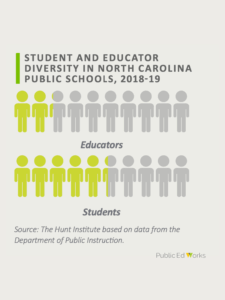
Specifically, in the 2023-2024 school year, 57.2% of North Carolina’s public school students identified as students of color, while 29.4% of the state’s educators are nonwhite.1
The National Council on Teacher Quality recently reported that our Educator Preparation Programs (EPPs) are not producing enough candidates of color to meet present or future workforce needs.2
This troubling trend echoes what the DRIVE Task Force warned years ago: Without intentional statewide action, students will continue to experience educators who “(do) not reflect or respond to the cultural, linguistic, and community strengths they bring into classrooms each day.” In the 2023-24 school year, 57.2% of North Carolina’s public school students identified as students of color, while only 29.4% of the state’s educators were nonwhite.
The original DRIVE recommendations remain both urgent and attainable. They call for North Carolina to:
•Expand affordable postsecondary access through scholarships, loan forgiveness, and tuition reimbursement programs that encourage diverse candidates to enter teaching.
•Build multiple on-ramps into the educator pipeline based on models with proven success recruiting racially, ethnically, and linguistically diverse educators.
•Invest sustainably in educator preparation programs at Historically Minority Serving Institutions (HMSIs) to expand their capacity as equity-driven leaders in teacher preparation.3
These recommendations are not theoretical. They are rooted in historical and contemporary models. North Carolina has already demonstrated most of the models to be effective.
The Flood Center continues to spotlight models to recruit and retain educators of color, even creating fellowships that can be scaled across the state because they demonstrate a shared truth that even during periods of political uncertainty around diversity, equity, and inclusion, North Carolina possesses strong, historically tested pathways to build a high-quality, representative educator workforce.
North Carolina also has an example in the NC Teaching Fellows, a proven strategy for recruiting and preparing talented educators particularly in high-need subject areas. Expanding Teaching Fellows to include more HMSIs and regional universities, while increasing slots for candidates of color, would accelerate progress toward a more representative workforce.
Efforts developed through the Flood Center such as the Charlotte Hawkins Brown Fellowship4 are grounded in community-connected educator development, leadership cultivation, and deep cultural affirmation.
Brown’s work teaches us that strong educators are not only academically prepared; they are socially anchored, supported, and developed in environments that value identity and belonging. Her model demonstrates how culturally rooted preparation can thrive, even in moments of political tension.
Similarly, the Jeanes Teachers model,5 which placed expert Black educators in schools and communities to coach, develop, and elevate instructional practice, offers a blueprint for strengthening today’s workforce.
Jeanes Teachers worked across districts, especially in rural communities, to build the instructional and leadership capacity of their peers. At a time when DEI funding and language are increasingly challenged, the Jeanes model provides a historically grounded, politically resilient framework: Invest in skilled educators who build the capacity of others, strengthen local pipelines, and raise professional standards from within communities.
Publicly available data reinforce this need for urgency. The DRIVE Dashboard,6 a resource built to monitor progress, shows persistent gaps in educator diversity, inconsistent recruitment trends, and wide disparities across regions.
Additionally, articles such as “Lessons Learned: NC Struggles to Recruit & Retain Educators”7 highlight how budget delays, stalled legislation, and insufficient investments undermine the profession’s stability. These issues directly affect not only who enters teaching, but whether educators remain in the classroom long-term.
The stall of HB 1047,8 legislation designed to strengthen educator diversity and pipeline support, exemplifies the challenge. Each year that passes without action deepens shortages and places additional strain on districts already struggling to recruit and retain educators; especially in rural counties and hard-to-staff subjects.
These delays worsen an already critical problem that threatens North Carolina’s constitutional promise: that every child is entitled to a sound, basic education.
North Carolina stands at a crossroads.9 We have the models. We have the data. We have decades of evidence showing what works. What remains is the political will to act.
To secure the future of public education, state leaders must invest in strategies that are both historically grounded and adapted for today’s realities, strategies that strengthen the workforce, honor community wisdom, and ensure every student is taught by educators who are prepared, supported, and reflective of the communities they serve.
The path forward is clear. The question is whether we will choose it.

Dr. Deanna Townsend-Smith is the Senior Director at the Dudley Flood Center for Educational Equity and Opportunity. She has led transformative efforts across North Carolina and beyond as a teacher, mentor, new teacher coach, administrator, and school turnaround expert. She previously served as Director of Board Policy and Operations for the North Carolina State Board of Education.
1 https://floodcenter.org/shared-files/37654/?DFC%20Issue%20Brief-%20Teacher%20Diversity%20.pdf.
2 https://www.newsobserver.com/news/local/education/article313288789.html.
3 https://floodcenter.org/wp-content/uploads/2024/01/HI-DRIVE-Final-Report.pdf.
4 https://floodcenter.org/charlotte-hawkins-brown-fellowship/.
5 https://floodcenter.org/jeanes-fellowship-program/.
6 https://floodcenter.org/drive/.
7 https://publicedworks.org/2025/09/lessons-learned-nc-struggles-to-recruit-and-retain-teachers/.
8 https://www.ncleg.gov/BillLookup/2023/H1047.
9 https://www.ncforum.org/we-knew-what-worked-we-still-do-the-fight-to-reclaim-public-education-for-the-public-good/2025/.