The six Governors seated in a pew at Jim Hunt’s funeral last month are of different parties, philosophies and personalities.
But all of them battled the General Assembly over power.
They were Josh Stein (2025-now), Roy Cooper (2017-2025), Pat McCrory (2013-2017), Bev Perdue (2009-2013), Mike Easley (2001-2009) and Jim Martin (1985-1993), whose two terms came between Hunt’s two eight-year stints in the office.
When Hunt took office in 1977, North Carolina’s governors were the weakest in the country. They were limited to one four-year term and, alone among all 50 states, didn’t have veto power.
Hunt passed constitutional changes allowing succession (in 1977) and veto (in 1996). He transformed the office and became a powerful and influential governor.
Since then, Democratic and Republican legislatures have eaten away at the office’s budget, appointment and administrative powers – regardless of the governor’s party.
Today’s Republican-majority legislature would make our governor once again one of the weakest in the nation.
Two legislators who have resisted and reduced governors’ powers also attended the service.
One was Senate President Pro Tem Phil Berger, who has led the Republican charge since 2010 to diminish – and assume – governors’ powers.
The other was Democratic Senator Dan Blue, who as House Speaker in 1993-94 blocked Hunt’s effort to pass veto.
Veto didn’t pass until Republicans took the House majority in 1994. They supported the veto after watching Democratic legislatures dismiss, ignore and override Governor Martin.
I’m for strong governors.
Legislators represent narrow, local constituencies. They’re subject to undue influence by special interests.
A strong governor, like Jim Hunt, can give the state big-picture, forward-looking leadership.
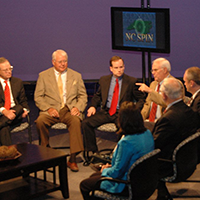
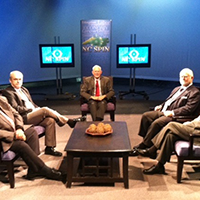
Governors Hunt, Martin, Easley, Perdue and McCrory in 2018. WUNC photo.