Revisiting George Washington on our 250th
Published June 11, 2026
By Gary Pearce
A recent visit to Mount Vernon made me reconsider this question: What was the greatest thing George Washington did?
Is it that he led a rag-tag, under-manned, under-equipped, under-funded Continental Army through eight years of war - and defeated the might and majesty of the British Empire?
Or that he was elected our first President - unanimously by the Electoral College, twice - and steered a fledgling republic through its uncertain early years?
That’s enough for greatness.
But he did something even more remarkable - something worth saluting in these political times - and he did it not once, but twice:
He willingly gave up power.
We all know about the second time he gave up power, when he stepped down from the Presidency after two terms. He could have stayed in office for life, but he set a precedent that stood until Franklin D. Roosevelt, when war again threatened America’s freedom.
Now the two-term limit is imposed by the 22nd Amendment to Constitution, though Donald Trump would break it if he could, like he’s broken the law and the Constitution so many times.
The first time Washington gave up power is less known, but more striking.
After the Revolution, he was the most popular man in America. He could have declared himself king or military dictator.
Instead, he travelled to the Continental Congress in Annapolis, Maryland, and, on December 23, 1783, resigned as commander-in-chief of the Continental Army.
He handed over his commission and said, “Having now finished the work assigned me, I retire from the great theatre of action.”
He returned to his home at Mount Vernon.
But retirement didn’t last.
In 1787, he answered the call to serve as president of the Constitutional Convention, which needed his status to legitimize the session.
He presided over four months of heated debate in a sweltering Philadelphia summer. He rarely spoke, instead quietly and firmly guiding the delegates toward consensus and compromise.
They agreed to establish a strong Presidency because they knew Washington would be first to hold the office and exercise its power.
At the end, he was the first to sign the new Constitution.
Gwyn and I learned all this and more last month when her cousin Ellen Moyseowicz - a “guide par excellence,” Gwyn dubbed her, at Mount Vernon - took us on a tour of the house, grounds and museum - all enlightened by her knowledge of the man and the historic site.
Ellen was off duty that day, but shifted into work mode when we were joined in the kitchen by a group of high-spirited high-schoolers, no doubt as clueless as I was when I last visited - on a sixth-grade field trip by Raleigh’s Frances Lacy Elementary School Safety Patrol.
No working guide was on hand, so Ellen took control, quieted the students and taught us all about cooking back in the day.
That evening, Ellen and her husband Thad hosted us at a wine festival that raised money for Mount Vernon, which is owned and run by a private foundation and receives no government funds.
Thad, a 30-year Navy man, told us that Navy ships still “render honor” to Washington as they pass his estate and tomb. Crew members line the rails, the ship’s bell rings and the commanding officer salutes.
At the wine festival, held on a beautiful May Saturday, hundreds of people gathered on the front lawn.
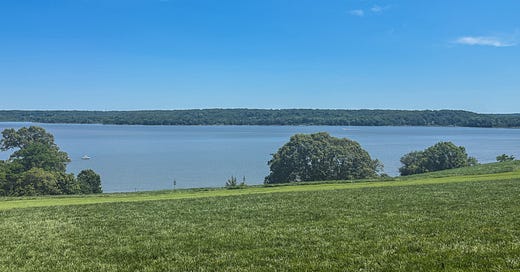
We enjoyed the spectacular view of the mile-wide Potomac River.
Across the river is Maryland, and the land there is protected forever against development.
You see what George Washington saw.
You see why he said, “No estate in United America is more pleasantly situated than this…on one of the finest Rivers in the world.”
If Washington came back today, he’d still enjoy the view from Mount Vernon.
But he wouldn’t like what he’d see in the city named for him - and in Trump.
As we celebrate the 250th anniversary of our independence, we might ponder the qualities George Washington brought to the Presidency that we’d like to see there again.
Like honesty, dignity, patience, steadfastness, sound judgment and self-sacrifice.
What would George do if he were here today?
He would no doubt say: No tyrant. No dictator. No King!
And he would no doubt answer the call to duty - again.
Photo: George Washington’s view from Mount Vernon.
You can subscribe to Gary's substack newsletter here