What's a North Carolina teacher to do?
Published April 15, 2026
By Tom Campbell
What can you do if you are a public employee and the body that determines your pay, work conditions and regulations governing your work is not only not supporting you but is actively encouraging students to go elsewhere? That’s the question North Carolina’s 90,000+ public school teachers are asking themselves.
The North Carolina Association of Educators is urging teachers to take the day off May 1st in protest. Call it what you like, but if it looks like a strike and feels like a strike it is still a strike. However, in North Carolina, public employees are forbidden from striking.
Educators in Los Angeles have been experiencing similar problems, however they can belong to unions. When they recently threatened a strike guess what happened? Leaders quickly responded by conducting talks and finding mutually acceptable resolutions.
But our legislators don’t have to try to find solutions to teachers’ requests and they don’t. So, what are teachers to do?
We don’t embrace unions but perhaps it is time to reconsider allowing unions for public employees. They need a place at the table and a voice in decision-making.
For years our General Assembly has refused to pay teachers a decent wage and they have fallen from paying the national average in the 1980s to 43rd in 2024. And it isn’t just pay that is suffering. The amount spent per student in NC is now 48th in the U.S.
“What’s your gripe,” some ask? After all, teachers take the whole summer off. That dog won’t hunt. Few teachers have just 8-hour workdays during the school year. Besides, school calendars have become compressed so that the summer break amounts to fewer and fewer days.
Teachers were once among the most respected people in town. If a teacher disciplined a child, the parents’ punishment was usually many times worse. Teachers tell me now that parents get irate if their child’s teacher dares to discipline them. More times than not the parents blame the teacher for the child’s misbehavior.
And just talk with a teacher about the stress they face to raise student performance test scores. State laws require that public schools educate all children and the typical teacher’s class is a mixture of student learners, ranging from those with special needs to those academically gifted. Yet the teacher is expected to teach to all the students in her classroom. Further, if class test scores aren’t stellar, who gets the blame? It’s not the state or the system. More times than not it is the teacher.
Let’s cut the noise about how easy teachers have got it. If teaching was such a picnic, why aren’t more people beating down the doors to get teaching positions? More than 9,000 teachers left the profession or took jobs in other states last year; besides, our schools of education are struggling to get college students to enroll.
Like every profession, there are some superb teachers. Their classrooms are magical. Parents and principals know who they are. There are also a large number who are good but not excellent. And some who are not good, but administrators will tell you they have a hard time culling out those not good because they have few options for replacing them. Folks aren’t lining up to teach.
This isn’t the first-time things have come to a crisis point. In both 2018 and 2019 teachers took similar actions. In both instances schools across the state were forced to close for a day as thousands of teachers (a reported 19,000 in 2019) protested. They flooded into downtown Raleigh, then marched to the legislature to demand better pay. In both those years their pay was increased. Still not up to the national average but raised.
Republicans, especially GOP legislators, loathe NCAE. The organization’s number of dues paying members has declined sharply in recent years, as has their influence. But, like them or not NCAE is still the loudest advocate for teachers. Its previous calls for strikes were effective and will be on May 1.
Sadly, some schools will close to students that day. That is undesirable, but things didn’t have to reach this point. Instead of making serious efforts working to improve traditional public schools, which included paying our teachers more respectably and funding our schools better, legislators threw up their hands, gave up and instead will provide $675 million for private school vouchers in the next school year.
Seems like many of our legislators are the ones who need to be learning lessons. Some of them will do so the hard way, come November 3rd.
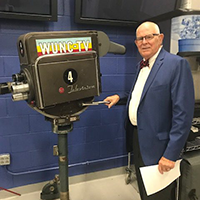
Tom Campbell is a Hall of Fame North Carolina broadcaster and columnist who has covered North Carolina public policy issues since 1965. Contact him at tomcamp@ncspin.com