Charlotte-Mecklenburg Schools just turned a painted spirit rock into a $95,000 civics lesson, after settling a lawsuit over Ardrey Kell High School’s decision to erase a student’s tribute to Charlie Kirk in the aftermath of his assassination.
The rock had long served as a free-speech emblem on the public school campus. Over the years, it had displayed all sorts of messages, from Black Lives Matter to sports teams. But when a student painted “Live Like Kirk, John 11:25,” school officials called it “vandalism.”
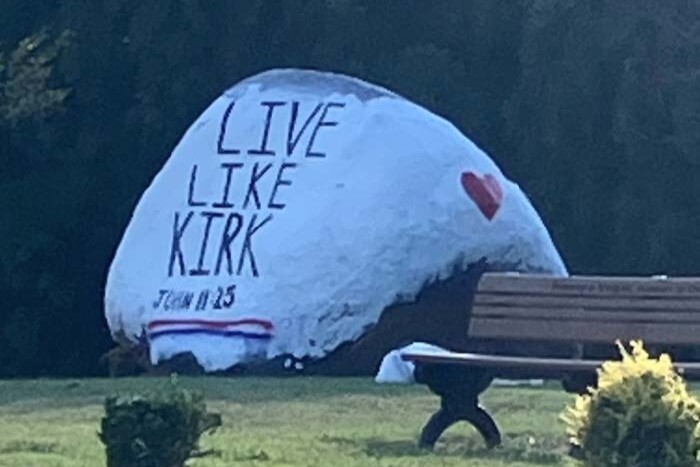
Despite following the procedure for approval to paint the rock, this high school junior was punished, ordered by public school administrators to turn over her phone and issue a statement. She says she was publicly humiliated by administrators. Just a few days later, the school issued a new policy allowing only “positive speech” and prohibiting religious messages. In other words, school officials made themselves the arbiters of allowable speech.
She and her family sued the school district. As part of the settlement, CMS must publicly clear her of wrongdoing and adopt a new student speech policy. Alliance Defending Freedomrepresented the student in G.S. v. Charlotte-Mecklenburg Board of Education.
“What happened to this student is outrageous,” said ADF senior counsel Travis Barham. “School officials should never censor, punish, or shame a student simply for sharing her views. Charlie Kirk boldly defended open and respectful discourse on school grounds literally until his last breath, and this courage inspired many across the country, including our client, whom Charlotte-Mecklenburg Schools officials treated so abominably. It is long past time for school officials to learn that they cannot promote student viewpoints they like while punishing students whose views they dislike. We hope the new policy prevents school officials from subjecting any other students to the abuse our client experienced and will instead force them to respect every student’s constitutional rights.”
Between this generation’s social media use and the enormous following Kirk inspired, one would think educators today would be more aware of student speech rights. But some bureaucrats, particularly in education, believe they are responsible for directing the values, not just the academics, of the next generation.
And they are shaping those values, but not in the way they think. This generation is more suspicious of authority and more likely to self-censor to survive the institutional education system. Students also have more access to a wider American perspective, and they are rightfully standing up for themselves.
When government schools and their employees believe they can punish disfavored or inconvenient speech, they put fundamental rights and taxpayers at risk. CMS didn’t just paint over a rock. It painted over a student’s constitutional rights, and taxpayers got the bill.
Many schools have a “spirit rock” on campus, suggesting that it provides a vehicle for free expression. There are generally rules about permission and content; that is not the issue here. In this case, the rules appeared to change when the message was Christian and conservative. Once schools invite student expression, they cannot change the rules because a few officials decide a viewpoint is too controversial.
This was a $95,000 civics lesson.
Hopefully, students and administrators learned that the First Amendment does not require school officials to agree with a student’s message. It requires them not to discriminate against it.
Free speech on campus appears to be in a constant state of challenge, and administrators play a crucial role in defending it. At UNC-Wilmington, after Kirk’s murder, the campus chapter of Turning Point USA painted the spirit rock in his memory and stayed up all night guarding it from being defaced. When opponents dumped paint over the memorial rather than honoring the 24-hour courtesy rule, school administrators basically shrugged.
“The UNCW spirit rock is not a memorial,” officials told a local news outlet at the time. “It is a platform for freedom of expression. Students typically paint the rock multiple times per week. Out of courtesy, students are asked to leave artwork for at least 24 hours before repainting, but no policy requires this.”
Censorship is not always as overt as painting over a message. Sometimes it happens through unfair grading, commentary from a tenured professor with a captive audience, or a student body empowered to believe mob rule can overrun the rights of others.
Last year, the Foundation for Individual Rights and Expression, or FIRE, found that 54% of UNC-Chapel Hill students self-censor at least once or twice a month, and 45% of students across North Carolina hold back their views at least monthly. In the same study, 73% of students across 10 North Carolina universities believed shouting down a speaker was acceptable. The state earned a D+ for speech climate.
Schools are often the primary interaction young people have with government, and they carry that experience into adult life. The deeper harm in these cases is not the legal fees and settlements. It is the message sent to students that expressing their beliefs can make them a target of the government.