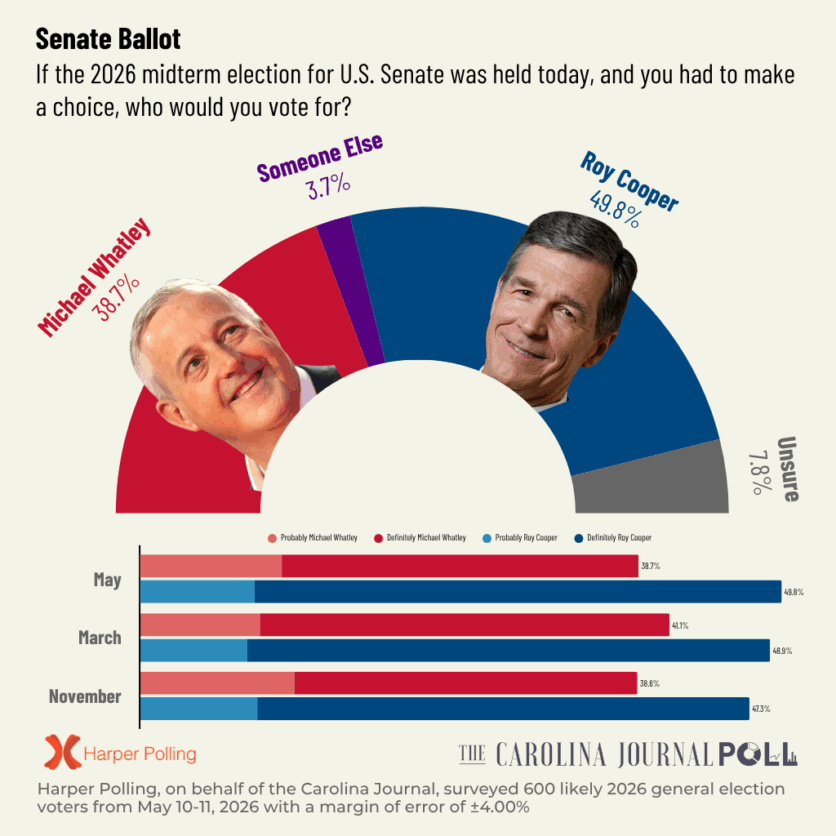
Former Governor Roy Cooper has expanded his lead in the race for North Carolina’s US Senate seat. The latest Carolina Journal Poll found that 49.8% of likely North Carolina voters support Cooper, while 38.7% support former Republican National Committee Chairman Michael Whatley. These results indicate an 11.1-point lead for Cooper — a noteworthy gain over March, when Cooper led by 7.8 points.
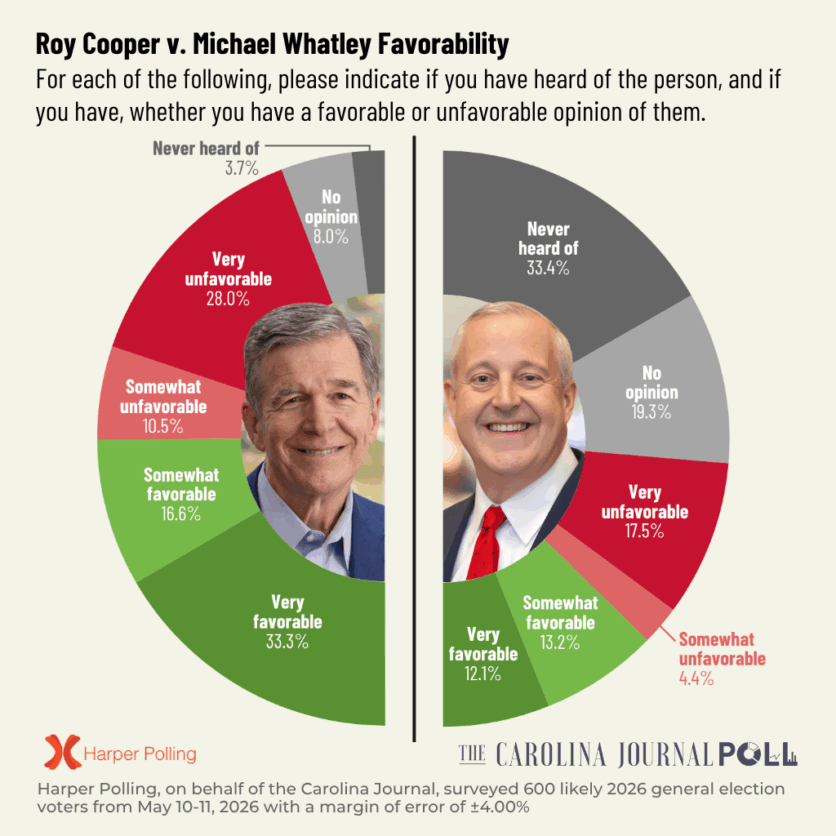
When questioned further, 49.8% of voters indicated a favorable view of Cooper, compared with 38.5% who expressed an unfavorable view. Whatley garnered a 25.4% favorability rating, while 21.9% shared an unfavorable view of him. A majority of voters (52.7%) either have no opinion (19.3%) or have never heard of (33.4%) Whatley, compared to just 11.7% of voters who have no opinion (8%) or have never heard of (3.7%) Cooper.
Whatley’s name ID is the lowest among women aged 18-34, with 64% claiming they have never heard of him, and his favorability is highest among men over the age of 65, at 38% favorability. Cooper’s favorability is particularly high with black voters, with 76% of black women and 74% of black men expressing a positive image of Cooper. His reputation among white men, however, is underwater: 49% of white male voters express an unfavorable view of Cooper, compared to 41% who view him favorably.
“Roy Cooper’s double-digit lead over Michael Whatley is real — but it’s not just a generic midterm backlash,” said Donald Bryson, CEO of the John Locke Foundation and publisher of Carolina Journal. “Cooper’s 24 years of statewide name recognition is a massive advantage that no challenger can easily overcome. At the same time, Republicans are fighting headwinds: President Trump’s approval is underwater, while a majority of North Carolinians say the country is on the wrong track. That combination makes this Senate race even more difficult for the party in the White House.”
Across the board, Democrats fared better than Republicans in this month’s poll. In the North Carolina Supreme Court race, Democrat Antia Earls (41.3%) leads Republican Sarah Stevens (35.6%) by 5.7 points. For the North Carolina General Assembly, 47.5% of voters say they plan to vote for a Democrat, while 41.3% plan to vote for a Republican.
For Congress, 48.2% of North Carolinians say they plan to vote for a Democrat, while 44.5% plan to vote for a Republican. This trend holds not just for candidates, but for sitting politicians as well. Democratic Governor Josh Stein has a majority approval rating (50.1%), with only 32.3% disapproving of the job he is doing as governor. Republican President Donald Trump, on the other hand, saw majority disapproval (56.6%), with only 41.5% approving of the job that he is doing in office. This month’s poll marks a new low in Trump’s approval rating among North Carolinians, as it is his lowest recorded approval rating in the Carolina Journal Poll since he began his second term.
Trump’s approval rating tracks the direction of the country, which has similarly hit a new low. A majority (57.7%) of voters say America is on the “wrong track,” while only 39.1% say it is headed in the “right direction.” However, Stein’s approval rating has remained stable despite, for the first time since September 2024, more than half of voters (53.5%) expressing that North Carolina was on the “wrong track,” marking a 7.1-point increase since March.
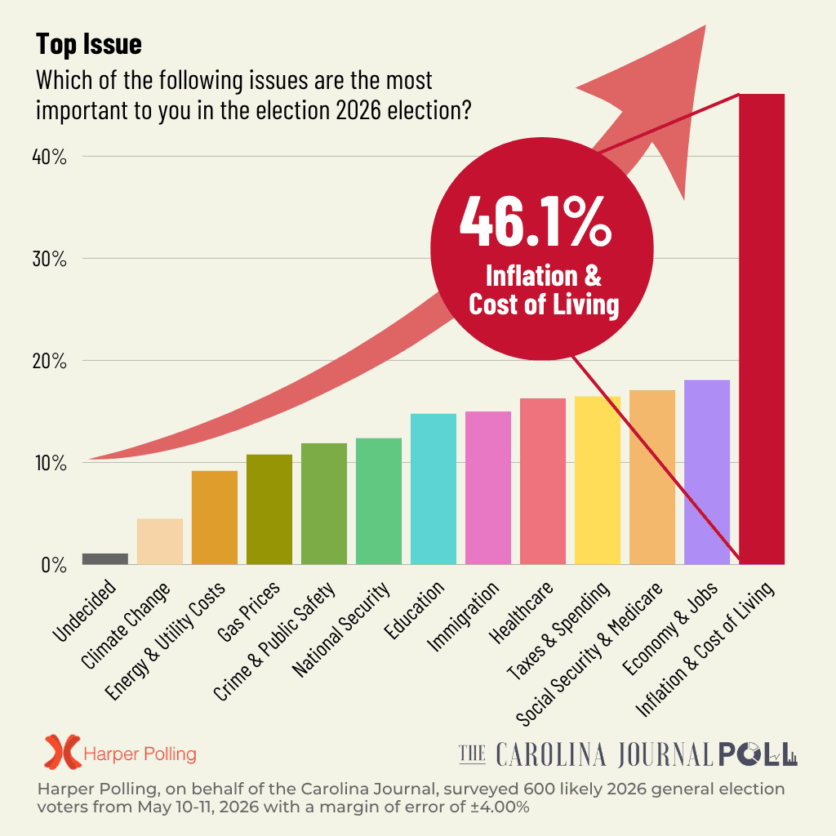
When prompted to select which two issues were most important in the 2026 election, inflation and cost of living (46.1%) made the top of the list, followed by economy and jobs (18.1%), Social Security and Medicare (17.1%), taxes and spending (16.5%), healthcare (16.3%), immigration (15%), education (14.8%), national security (12.4%), crime and public safety (11.9%), gas prices (10.8%), energy and utility costs (9.2%), climate change (4.5%), and undecided (1.1%).
Cost of living being voters’ top concern, we asked voters their view on the best way for North Carolina to stay affordable. A majority (62%) said “North Carolina should focus on keeping taxes low, reducing unnecessary government barriers, and expanding economic opportunity,” while 20.6% of voters said the state should “focus on increasing investment and government programs and public services.” A combined 17.4% were either unsure (9.4%) or supported neither of those perspectives (8%).
Along the lines of “reducing unnecessary government barriers,” the survey included a question on zoning requirements. A majority (53.5%) of voters would support “changing state and local zoning rules to make it easier to build more homes in North Carolina if doing so could help address housing shortages and improve affordability,” while 36.5% oppose easing zoning restrictions. Voters in urban areas (69%) were the most likely to support relaxing zoning restrictions, while suburban voters (48%) were the least convinced.
An even more popular deregulation proposal is allowing private retailers, such as grocery stores, to sell liquor in North Carolina. Nearly three-fifths of voters (58.6%) support expanding liquor sales outside of ABC stores, with 30.8% of voters in opposition.
When asked about which two concerns the North Carolina government should prioritize, voters’ top selections were keeping taxes low and protecting taxpayers (47.0%), ending favoritism, cronyism, and special deals for politically connected groups (46.6%), and improving education (43.9%). Voters were less concerned about reducing unnecessary regulations and government barriers (20.3%), expanding job opportunities (18.3%), and increasing government spending on public services (13.5%).
Voters’ priority to keep taxes low is reflected in their opinions about property tax reform. The North Carolina General Assembly has been considering two paths for property tax relief. The House’s preferred method is a levy limit, which would limit the rate that property taxes can increase, and the Senate’s preferred method has been a moratorium on reevaluations. While many taxpayers support both approaches (42.9%), a levy limit (31.2%) appears to be more popular than a reevaluation moratorium (4.6%).
“The recent announcement from the General Assembly’s leadership advancing a constitutional levy limit is an astute move for property tax reform and likely to win on the November ballot,” continued Bryson. “Our polling shows that is exactly the call voters want — North Carolinians overwhelmingly support a constitutional amendment to limit future property tax increases.”
Improving education was also among voters’ top priorities for state government. One method to improve education, the Opportunity Scholarship Program, has strong majority support, with 65.1% supporting the program that offers publicly funded scholarships that help students attend the school that best fits their needs, including private, charter, and homeschools. Approximately a quarter of voters (26%) oppose this program.
Following the May 1 teacher walkout, the Carolina Journal Poll surveyed voters on their support for this cause. A majority of voters (53.7%) supported closing schools for the rally, while 39.1% opposed. Urban voters (25%) were the least likely to oppose the teacher rally, while rural voters (49%) were the most likely to oppose school closures.
The divide between urban and rural voters is also apparent in opinions on Medicaid spending. While a majority (68.5%) of voters are concerned about North Carolina’s 97% increase in Medicaid expenditures since 2021, rural voters expressed the greatest concern, with 48% stating that they were “very concerned” about this issue, while 36% of urban voters stated that they are “unconcerned.”
One idea that has been proposed to address ballooning healthcare costs is to end Certificate of Need laws in North Carolina. Most North Carolinians (64.8%) said that they would support allowing more healthcare providers to open facilities, add beds, or offer services if they meet safety and licensing requirements, without having approval from the state government that there is a “need” for the service. Only 20% of voters oppose ending this certificate of need requirement.
Even fewer voters oppose expanding practice authority for Advanced Practice Registered Nurses (APRNs). More than three-quarters of voters (75.3%) support ending the limitations on APRNs, including the requirement for a supervising or sponsoring physician. Only 16% of voters oppose this measure.
A measure with significantly less support is repealing North Carolina’s defunct literacy test in the state constitution. Despite the literacy test being unenforceable since the passage of the Voting Rights Act of 1965, a plurality of voters (41.4%) oppose repealing it from the state constitution. These results are similar to those from Carolina Journal’s last poll on this question in August 2024, which showed 38.6% opposition to repealing the literacy test. This difference falls within the poll’s ±4.00% margin of error.